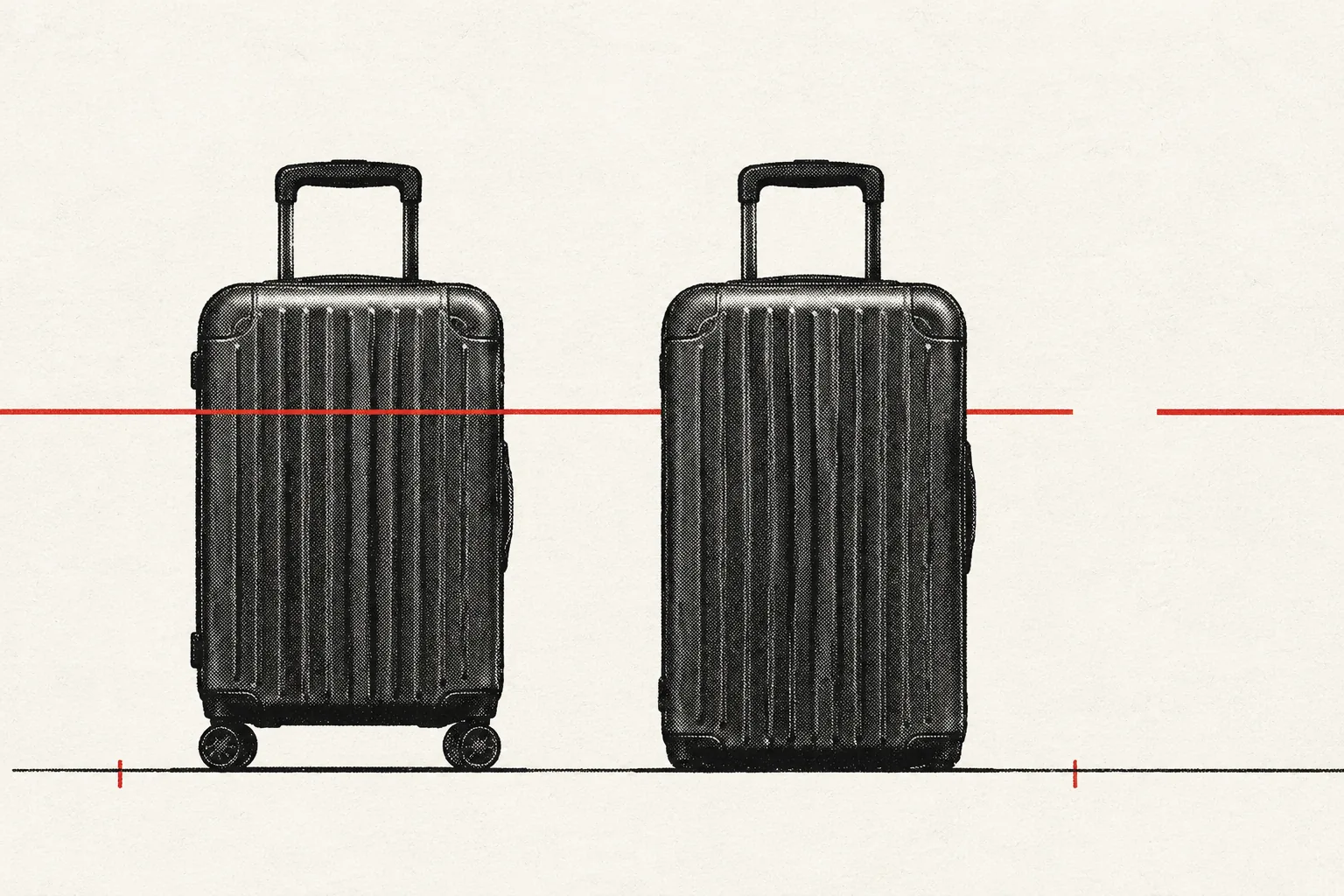
Why Cabin Luggage Limits Depend on Centimetres, Not Inches
Cabin size compliance is decided strictly in centimetres by airline rules, not by the nominal inch labels displayed in retail stores. A typical 20-inch suitcase can measure 37.6 x 22.6 x 58.4 cm overall once wheels and handles are included, which makes it taller than a standard 55 cm airport sizer frame. Relying on a "20-inch" tag without checking exterior metric dimensions is the primary reason carry-on bags get rejected at the gate.
Cabin allowances vary across different carriers and aircraft configurations, with typical published sizer limits falling near 55 x 40 x 20 cm or 56 x 36 x 23 cm. The airline ticket terms and the physical metal sizer box at the gate make the final determination, never the product name. If any part of the shell, wheel assembly, or fixed grip protrudes past those steel borders, the case cannot travel in the overhead locker.
For product developers and commercial procurement teams, this discrepancy demands strict specification standards. Factories measure nominal shell molds in inches, but airport baggage checks evaluate the total three-dimensional envelope. Every clearance check must measure from the rolling surface of the wheels to the highest ridge of the retracted handle, ensuring the finished product conforms to airline centimetre thresholds rather than marketing shorthand.
Overall Dimensions in Centimetres: How Wheels and Hardware Alter Cabin Fit
In standard luggage manufacturing, a "20-inch" designation refers strictly to the shell body, but airport baggage sizers measure the complete external envelope from the floor to the top handle. For example, our 20-inch Voyager zipperless aluminium frame model measures 37.6 x 22.6 x 58.4 cm overall, including wheels and handles. At 58.4 cm tall, it will not drop into a rigid 55 x 40 x 20 cm test frame, even though the retail tag designates it as a standard 20-inch cabin case.
How the wheel casters and trolley housings are integrated into the shell directly dictates whether a piece meets cabin limits. Consider four different production configurations carrying the same 20-inch label:
- Voyager zipperless aluminium frame: 37.6 x 22.6 x 58.4 cm, 39 L packing volume, 4.38 kg empty weight.
- Captain zipperless: 38 x 23 x 54 cm, 48 L packing volume, 4.85 kg empty weight.
- Captain aluminium frame: 54.1 x 36.6 x 23.9 cm, 39 L packing volume, 4.04 kg empty weight.
- Aluminium suitcase line: 54.1 x 36.6 x 23.9 cm, 45 L packing volume, 3.7 kg empty weight.
While the Captain models keep total height to 54 cm or 54.1 cm by using sunken wheel housings, the Voyager extends to 58.4 cm. Furthermore, volume across the identical nominal size varies from 39 L to 48 L, and empty weights range from 3.7 kg to 4.85 kg due to frame construction and internal wheel well intrusion. For trade buyers writing a technical bill of materials, specifying outer dimensions in exact centimetres—including wheels and retracted handle clearances—is the only way to ensure compliance with common 55 x 40 x 20 cm or 56 x 36 x 23 cm gate templates.
Why 20-Inch Suitcases Vary Between 39 and 48 Litres
Nominal sizing does not define usable volume. Across four different production models bearing the identical 20-inch designation, internal packing capacity ranges from 39 to 48 litres, while tare weight spans from 3.7 kg to 4.85 kg. This variation occurs because the 20-inch label typically refers to an approximation of shell height, ignoring corner radii, shell depth, wheel integration, and structural framing.
| Model Specification | Overall Dimensions (cm) | Volume | Empty Weight |
|---|---|---|---|
| Voyager Zipperless Aluminium Frame | 37.6 x 22.6 x 58.4 | 39 L | 4.38 kg |
| Captain Zipperless | 38 x 23 x 54 | 48 L | 4.85 kg |
| Captain Aluminium Frame | 54.1 x 36.6 x 23.9 | 39 L | 4.04 kg |
| Aluminium Suitcase Line | 54.1 x 36.6 x 23.9 | 45 L | 3.70 kg |
Internal packing space is always smaller than exterior measurements because published figures account for the complete profile, including wheels, top handles, and side feet. The way the trolley housing and wheel assemblies are recessed into the shell directly dictates internal loss. For example, two cases with identical external envelopes measuring 54.1 x 36.6 x 23.9 cm yield 39 litres in a heavy structural frame versus 45 litres in a standard aluminium build.
For procurement specifications, relying on diagonal or shell-only inch callouts introduces commercial risk. Brand owners and buyers must specify both the total outer envelope in centimetres and the net internal volume in litres to ensure the final product meets functional requirements without exceeding overhead sizers.
How to Check Exterior Luggage Dimensions Against Airline Allowances
To verify whether a cabin case will pass gate inspection, always measure its maximum outer envelope rather than relying on the retail tag. Set the suitcase upright on a flat floor and measure from the bottom of the wheels to the highest point of the retracted trolley or carry handle. Next, measure the widest points across the front and side, accounting for external lock housings, side handles, and protective feet. A label claiming a 20-inch format often measures only the bare shell height, leaving out the 4 to 8 centimetres added by the wheel assemblies and trolley hardware.
Once you have the total exterior measurement in centimetres, compare it against your ticket conditions. Typical airport metal sizers are built around dimensions such as 55 x 40 x 20 cm or 56 x 36 x 23 cm. A case measuring 37.6 x 22.6 x 58.4 cm will protrude out of a 55 cm sizer box, even though it is marketed as a standard 20-inch carry-on. Conversely, a model built to 38 x 23 x 54 cm or 54.1 x 36.6 x 23.9 cm remains under standard 55 cm or 56 cm height thresholds, though its depth must still fit the specific side slot.
For brands and corporate buyers writing production technical sheets, never specify cabin inventory solely by diagonal inches or internal shell volume. State the total exterior boundary in centimetres, including wheels and hardware. The airport sizer and cabin crew examine the physical envelope that must fit into the overhead locker; internal packing capacity does not determine boarding compliance.
What to Include in Your Cabin Luggage Technical Specification
Ordering carry-on luggage simply by nominal shell size—such as a "20-inch case"—leaves critical dimensional tolerances undefined. Because common airport sizers measure approximately 55 x 40 x 20 cm or 56 x 36 x 23 cm, a factory variation of just two or three centimetres in castor clearance or handle extrusion can result in a product that fails gate checks. A production tech pack must define the total envelope, not just the bare moulded shell.
When drafting specifications for commercial production, explicitly mandate the following three parameters:
- Overall outer dimensions: State the maximum allowable height, width, and depth measured from the ground to the top of the retracted handle, including wheel assemblies and corner protectors. Depending on trolley integration and wheel diameter, 20-inch models can stand anywhere from 54 cm to 58.4 cm tall.
- Net packing capacity: Define usable internal volume separately from exterior displacement. Corner radii, zipperless aluminium frame profiles, and wheel arch cutaways affect capacity significantly; for example, different 20-inch tooling designs yield internal volumes ranging from 39 litres to 45 litres or 48 litres within similar exterior boundaries.
- Tare weight targets: Frame construction heavily influences empty weight. Depending on whether you select an aluminium suitcase line or a heavy-duty zipperless design, empty unit weight can vary between 3.7 kg and 4.85 kg. Specify tare thresholds early, as unladen mass directly reduces the customer's usable baggage allowance.
Always require pre-production sign-off based on fully assembled envelope measurements rather than mould drawings alone. Verifying outer perimeter clearance before full-run assembly prevents cross-border shipping delays and customer returns caused by non-compliant gate dimensions.