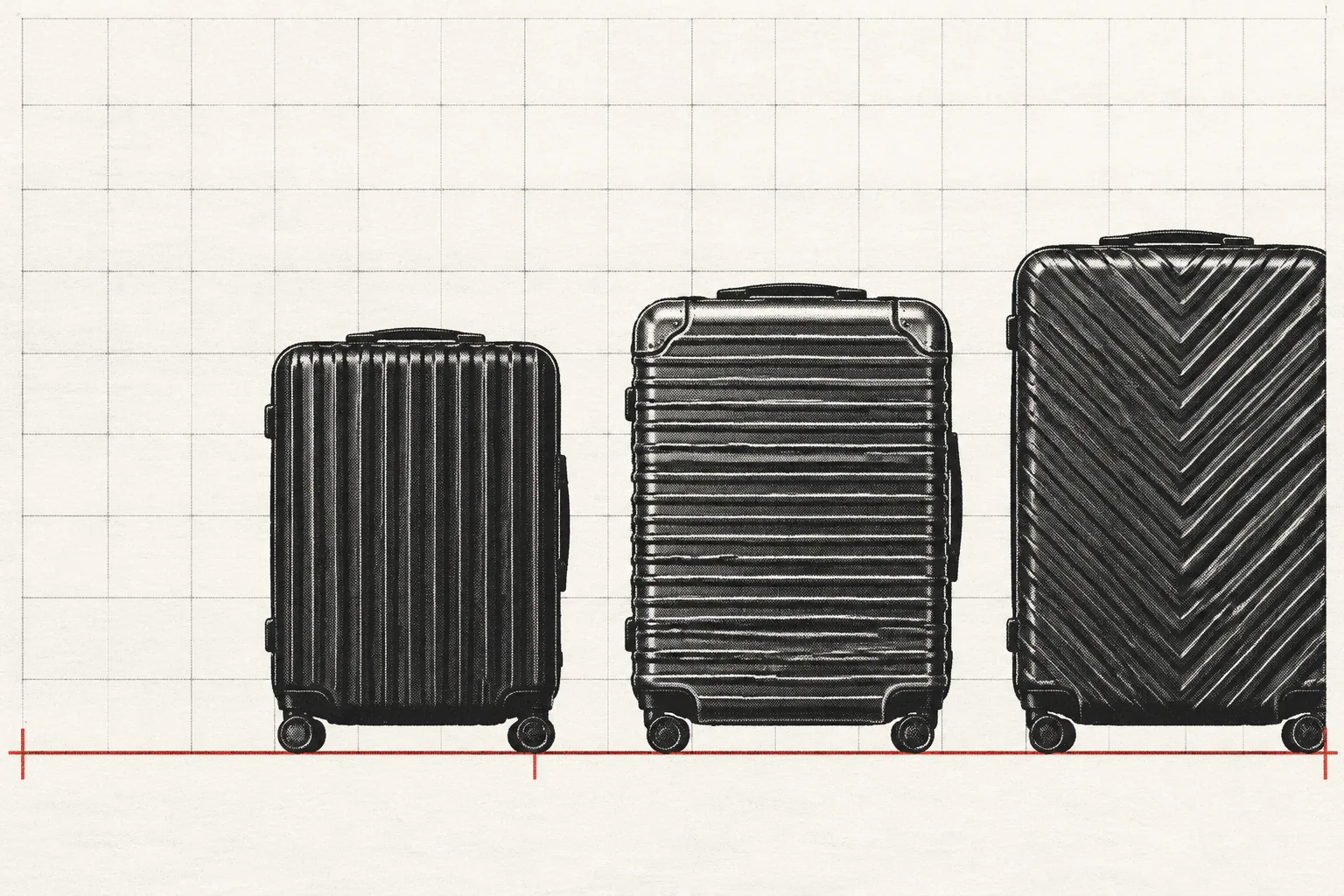
Checked Luggage Dimensions in Centimetres: 24, 26, and 28-Inch Specifications
When selecting check-in luggage, nominal inch ratings often obscure the actual physical space a case occupies. Outer dimensions must include retracted trolley handles, side grab handles, and wheel assemblies. In standard production, a 24-inch Voyager hard case measures 37.6 x 30.5 x 65.5 cm with an empty weight of 4.88 kg, yielding a linear total of 133.6 cm and a 60-litre packing volume. A standard 28-inch check-in case measures 49.5 x 32 x 68.5 cm with an empty weight of 5.2 kg and a linear total of 150.0 cm.
The 26-inch medium-large format is less common across standard manufacturing runs. While lines like the Voyager and Captain zipperless transition directly from 24-inch to 28-inch shells, the 26-inch footprint is manufactured exclusively within the AURA Collection and the Captain aluminium-frame series. The Captain aluminium-frame 26-inch model measures 69.1 x 46.0 x 26.4 cm, holds 73 litres, and weighs 5.35 kg empty, offering an intermediate volume between standard mid-size and maximum-capacity shells.
Evaluating these measurements against standard baggage allowances requires factoring in tare weight. Against a standard 23 kg check-in threshold, an empty 28-inch case weighing 5.2 kg leaves exactly 17.8 kg for packed cargo. If selecting a reinforced design such as the Captain aluminium-frame 28-inch (73.9 x 48.5 x 26.9 cm, 85 L), the empty weight increases to 6.3 kg, leaving 16.7 kg of usable payload within that same 23 kg limit.
Linear Dimensions Calculated Across Standard Check-in Sizes
Checked baggage compliance is calculated by adding overall length, width, and height together, including protruding wheels, top handles, and side feet. For consumers checking luggage measurements and commercial buyers planning size assortments, calculating these external boundaries ensures the case remains compliant with standard linear allowances.
For mid-sized check-in models, total dimensions remain well below threshold limits. The 24-inch Voyager measures 37.6 x 30.5 x 65.5 cm, resulting in a linear total of 133.6 cm and a 60 L capacity. Stepping up to the intermediate 26-inch tier, the Captain aluminium-frame model measures 69.1 x 46.0 x 26.4 cm, yielding a linear sum of 141.5 cm and 73 L of packing capacity.
At the 28-inch level, shell architecture and frame construction alter external measurements across different production lines. The standard 28-inch case measures 49.5 x 32 x 68.5 cm, totaling 150.0 linear cm (volume for this shell is not published). For structural variants, the 28-inch Captain aluminium frame measures 73.9 x 48.5 x 26.9 cm (149.3 linear cm, 85 L), whereas the full aluminium suitcase line measures 77.0 x 51.1 x 29.5 cm, bringing its linear total to 157.6 cm for 105 L of interior packing volume. Tracking these sums ensures distributors select shells that deliver maximum internal capacity without exceeding external geometric standards.
26-Inch Luggage: Tooling Availability Across Product Lines
While 24-inch and 28-inch cases serve as the standard check-in formats across the luggage industry, the intermediate 26-inch profile is not tooled across every collection. In our factory lineup, a 26-inch shell is manufactured exclusively for two series: the AURA Collection and the Captain aluminium-frame line. Both of these specific lines operate on an extended four-size matrix consisting of 20, 24, 26, and 28 inches.
Conversely, the Voyager collection and the Captain zipperless series skip this intermediate tooling entirely, running standard three-tier assortments of 20, 24, and 28 inches. Distributors and brand owners planning their SKU assortments must account for these production realities, as ordering a 26-inch check-in case requires selecting either the AURA or the Captain aluminium-frame chassis.
In physical terms, the Captain aluminium-frame 26-inch measures 69.1 x 46.0 x 26.4 cm overall, with wheels and retracted handles included. The build provides an internal capacity of 73 liters at an empty weight of 5.35 kg. For commercial assortments, this intermediate footprint provides a middle ground for consumers seeking more packing space than a 60-liter 24-inch model without carrying the larger exterior bulk of a full-size 28-inch shell.
Tare Weight Versus Usable Payload Under a 23 kg Baggage Limit
Every kilogram dedicated to the suitcase structure directly reduces the gear a passenger can check. Under a standard 23 kg limit, shell material and framing determine the real payload capacity long before packing begins. Evaluating dimensions alone overlooks this operational balance: larger cases often carry structural reinforcements that consume a significant share of the weight margin.
The arithmetic is straightforward when looking at measured tare weights across constructions:
- 24-inch Voyager (4.88 kg): Leaves 18.12 kg of usable packing weight from a 23 kg baseline, providing 60 L of interior packing volume.
- Captain aluminium frame 26-inch (5.35 kg): Yields 17.65 kg of net packing weight with an internal volume of 73 L.
- Standard 28-inch / Captain zipperless (5.2 kg): Leaves 17.8 kg of packing allowance for personal goods.
- Aluminium suitcase line 28-inch (5.7 kg): Leaves 17.3 kg of usable payload while delivering 105 L of volume.
- Captain aluminium frame 28-inch (6.3 kg): Leaves 16.7 kg of payload from the 23 kg allowance, offering 85 L of space.
A heavier structural profile noticeably restricts the traveler's margin. The Captain aluminium-frame 28-inch at 6.3 kg leaves 16.7 kg of payload, whereas a 5.2 kg zipperless 28-inch shell leaves 17.8 kg—a difference of 1.1 kg in packing capability. For distributors structuring a catalogue, stocking both framing styles ensures buyers can prioritize either the structural rigidity of perimeter aluminium channels or the maximized payload of lighter closures.
Selecting Checked Baggage Sizes for Your Distribution Assortment
For brand owners and distributors planning catalog inventory, size assortments typically center on a standard three-tier run of 20, 24, and 28 inches. Mid-sized 26-inch cases are not universally available across every production mold. Lines such as the Voyager and Captain zipperless run strictly in 20, 24, and 28-inch formats with no 26-inch option. If your customer profile demands an intermediate checked case, you must allocate inventory specifically to the AURA Collection or the Captain aluminium-frame line, where the 26-inch mold measures 69.1 x 46.0 x 26.4 cm, holds 73 L, and has an empty weight of 5.35 kg.
When balancing 24-inch versus 28-inch orders, tare weight versus packing payload is the primary operational consideration. In a standard 23 kg checked weight allowance, empty shell weight directly limits what the traveler can carry. A standard 28-inch case weighing 5.2 kg leaves 17.8 kg of net usable capacity. Moving to the heavier Captain aluminium-frame 28-inch at 6.3 kg reduces usable packing allowance to 16.7 kg. By contrast, a 24-inch Voyager shell weighs 4.88 kg and provides 60 L of capacity, leaving 18.12 kg for contents within the same limit.
Outer dimensions also vary depending on shell architecture. The standard 28-inch overall footprint of 49.5 x 32 x 68.5 cm produces a linear total of 150.0 cm, comfortably below the standard 158 cm combined limit. However, the Captain aluminium-frame 28-inch measures 73.9 x 48.5 x 26.9 cm (85 L), while the all-aluminium suitcase line 28-inch measures 77.0 x 51.1 x 29.5 cm (105 L, 5.7 kg). Stocking a balance of 24-inch cases alongside specific 28-inch constructions ensures retail end-users can optimize either maximum volume or available payload weight.