Essential Luggage Factory Audit Checklist: On-Site Stations and Red Flags
Evaluating luggage contract manufacturers in Southeast Asia requires verifying primary production assets rather than relying on showroom samples. A common sourcing risk involves engaging facilities that present themselves as full-scale manufacturers but operate merely as light manual assemblers, outsourcing critical shell forming and tooling to unverified third parties. Sourcing directors and supply chain auditors must systematically inspect production floor operations to confirm genuine manufacturing capability.
| Audit Station | Key Verification Points | Critical Red Flags |
|---|---|---|
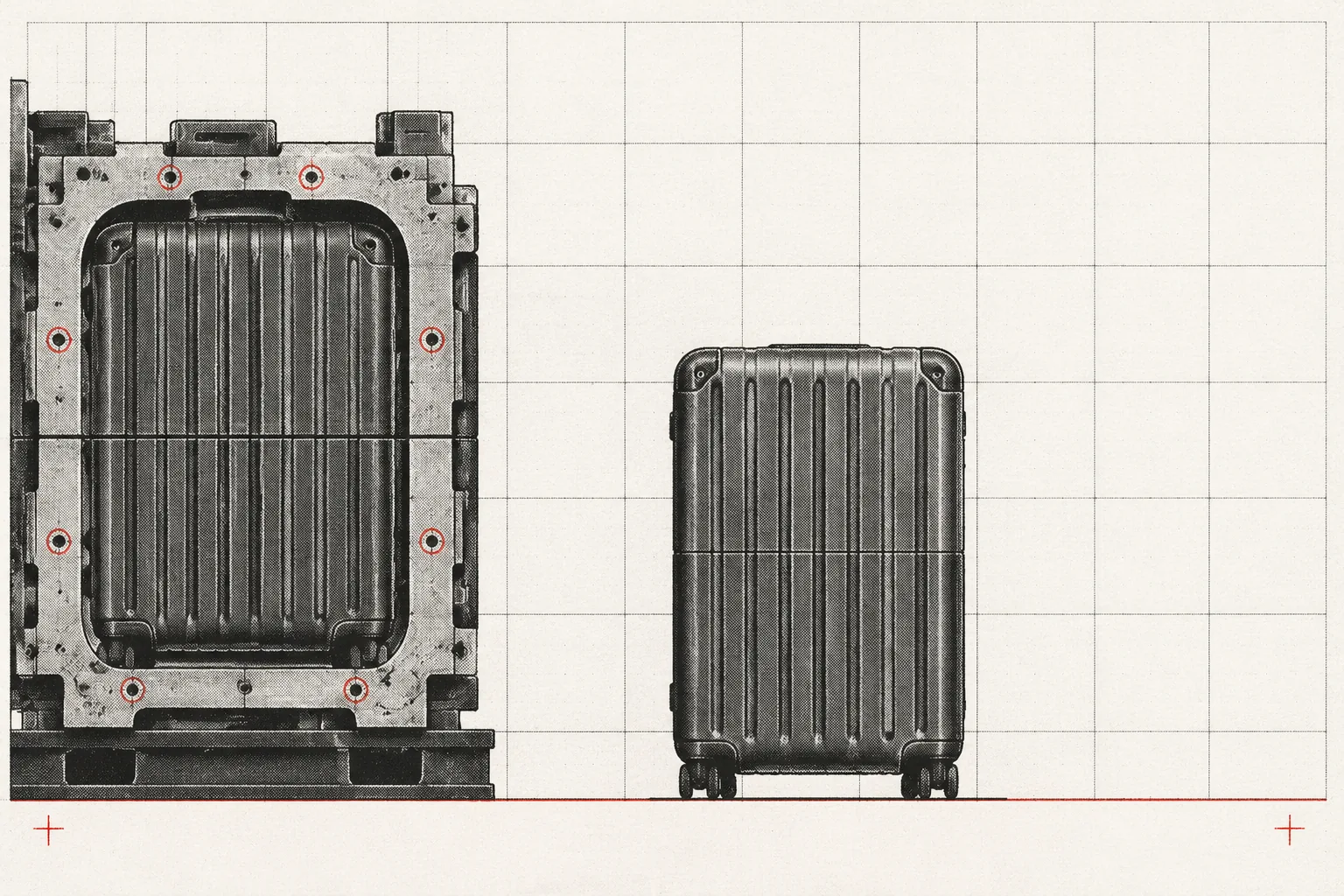
| Shell Forming | Operational heavy machinery (such as 1,500-tonne injection moulding presses), raw PC/ABS or PP resin storage, and active mould-handling tooling. | No heavy machinery on-site; pre-formed shells delivered from external vendors in secondary packaging. |
| Quality Control (IQC & IPQC) | Documented inspection logs for incoming raw resins, zippers, aluminium frames, and trolley systems; active line-side defect tracking. | Lack of receiving inspection logs; parts moved directly from receiving docks to assembly lines without verification stamps. |
| In-House Testing Laboratory | Calibrated physical testing equipment on-site, including drop test rigs with solid steel impact bases, mileage drums, and salt spray chambers. | Absence of functional test apparatus, non-operational equipment covered in storage, or reliance solely on off-site lab reports. |
| Final Assembly and OQC | Multi-stage assembly lines with standardized work instructions, dedicated rivet inspection, alignment checks, and AQL-based packaging control. | Disorganized manual workstations without assembly jigs, unchecked structural clearances, and absent lot-traceability coding on finished cartons. |
A primary contract manufacturer integrates sheet extrusion or heavy injection moulding alongside assembly operations within a single facility. When auditing hardshell production, confirming installed tonnage, tooling infrastructure, and standardized Incoming Quality Control (IQC), In-Process Quality Control (IPQC), and Outgoing Quality Control (OQC) prevents unexpected production bottlenecks, unverified material blending, and sub-tier supplier markups.
Raw Material Assessment and Injection Machine Tonnage Verification
A rigorous on-site audit begins where raw inputs enter the manufacturing process. Many luggage facilities market themselves as primary manufacturers but operate merely as assembly operations that outsource shell pressing. Sourcing teams must verify equipment assets on the shop floor. For large-format polypropylene (PP) and PC/ABS hardshell luggage, sufficient clamping force is essential to prevent internal structural voids, excessive flash, and uneven shell wall thickness. Auditors should directly inspect machine nameplates; at PT DJI Travel Products Indonesia's 10,000 m² facility in Kemang, Bogor, shell production is powered by two 1,500-tonne injection moulding machines supported by 100% in-house mould making capability.
Auditors must cross-examine injection parameters against daily machine logs. Confirm that hydraulic pressures, barrel temperature profiles, and cooling cycle times match the technical data sheets required for specific polymer formulations. Facilities possessing 1,500-tonne machinery have the necessary hydraulic capacity to process high-viscosity resins consistently across multi-cavity or large luggage body moulds without introducing residual thermal stress into the casing.
Material integrity must be verified through the Incoming Quality Control (IQC) protocol. Sourcing teams should inspect raw resin staging areas to verify virgin polymer packaging, masterbatch blending systems, and supplier certificates of analysis. If recycled edge trim or regrind is integrated into production lines, audit the regrind ratio controls. Excessive or uncalibrated regrind content degrades tensile strength and directly compromises impact resistance under cold-weather conditions. Ensure material hoppers and desiccant dehumidifying dryers run at verified processing temperatures before resin feeds into the injection barrel.
Assembly Line Auditing: Evaluating Shell Perforation, Riveting, and Closure Integration
During an on-site factory audit of the assembly floor, sourcing teams must inspect In-Process Quality Control (IPQC) stations along active production lines. Shell perforation for trolley systems, carry handles, and wheel caster housings requires dedicated routing fixtures or standardized punching jigs. Auditors should verify that cutouts do not exhibit micro-cracking, irregular burrs, or thermal deformation in PC/ABS or PP substrates, as misaligned perforations introduce uneven mechanical stress that compromises drop resistance.
Hardware riveting requires strict physical evaluation on the line. Auditors must examine the interior backing of fastened components to verify that structural reinforcement plates and load-spreading washers are correctly positioned. Pneumatic or hydraulic riveting tools must apply calibrated pressure; over-crimping crushes thermoplastic shells, while under-crimping causes hardware play. When auditing aluminium frame luggage, verify that rivet installation does not distort the structural rim (rated at Brinell hardness ≥40 HWB) or fracture the 10–12 μm anodic oxidation layer.
Closure installation inspection depends on luggage construction. For zippered models, auditors must check stitching pitch uniformity, thread tension, and edge margin consistency where the zipper tape binds to the shell. Skipped stitches, puckering, or needle perforation tears indicate inadequate machine calibration. For zipperless aluminium models, evaluate the perimeter channel fitment: the co-extruded waterproof gasket must seat continuously without stretching or bunching, ensuring flush alignment between upper and lower shells upon latch engagement.
Inline Quality Control: Auditing IQC, IPQC, and AQL Outgoing Inspections
A rigorous quality architecture requires verifiable isolation gates at every stage of luggage manufacturing. During an on-site audit, sourcing teams must inspect how the factory manages Incoming Quality Control (IQC) before materials reach the assembly floor. For PC, ABS, and PP compounds, this involves checking resin purity and batch consistency. For hardware components—including telescopic trolley systems, spinner wheels, zippers, and extruded aluminium frames—IQC technicians must verify dimensional tolerances, coating finishes, and mechanical action against technical drawings before releasing lots into active inventory.
In-Process Quality Control (IPQC) monitors operations directly across the four production lines. Station inspectors evaluate hardshell integrity immediately after injection moulding or forming, flagging cycle defects such as sink marks, uneven wall thickness, or flash along parting lines. As cases move through liner stitching, frame riveting, and wheel installation, IPQC personnel audit torque tolerances, seam straightness, and frame closure alignment. Any component or sub-assembly failing structural checks must be tagged and immediately routed to a designated physical quarantine zone to prevent defective work-in-progress from advancing downline.
The final defense is Outgoing Quality Control (OQC), executed via standard Acceptable Quality Limit (AQL) random sampling on fully packaged master cartons. OQC inspectors evaluate overall cosmetic condition, label accuracy, wheel rolling balance, lock combination functionality, and handle retention under load. Lots that fail AQL defect thresholds trigger immediate quarantine of the entire production batch for 100% screening and rework. Sourcing auditors should inspect these physical quarantine cages and review sign-off logs to confirm that defect handling follows systematic protocols rather than ad-hoc floor decisions.
Physical Testing Protocol and Export Documentation Verification
An on-site audit must confirm that performance claims are backed by calibrated testing machinery rather than third-party marketing sheets. Sourcing teams should inspect the on-site laboratory for five baseline stress tests: low-temperature conditioning chambers, drop towers, static load platforms, mileage test drums, and salt spray chambers. Genuine original equipment manufacturers validate durability using standardized physical parameters:
- Impact resistance: Free-fall drop testing from 900 mm onto a solid carbon steel plate at room temperature (18–25°C), as well as a 90 cm drop following low-temperature conditioning at -12°C for 4 hours.
- Static load capacity: Continuous 4-hour top-load pressure testing utilizing 40 kg weights for 535–660 mm cases and 60 kg weights for 685–835 mm shells to verify structural recovery without permanent buckling.
- Wheel and castor endurance: Running loaded 4-wheel assemblies across a continuous 12 km cycle (8 km cement drum, 2 km ribbed obstacle belt, and 2 km secondary surface) with an abrasion wear limit of ≤2 mm, supplemented by 25 consecutive drop-impact steps from a 200 mm height.
- Hardware and frame integrity: A 16-hour neutral salt spray test per ISO 9227 / ASTM B117 allowing no more than 3 corrosion spots (each ≤1 mm²). For aluminium frames, verify rim hardness meets ≥40 HWB per ISO 6506 / ASTM E10 and anodic oxidation film thickness measures 10–12 μm.
Beyond structural testing, compliance audits require reviewing cross-border clearance capabilities. Indonesian manufacturing operations exporting to primary destinations—including the United States, Germany, the United Kingdom, Australia, and China—must demonstrate routine processing of Indonesian Certificates of Origin (COO / SKA). Verify that the export compliance desk regularly issues preferential tariff documentation such as Form D, Form E, RCEP, IJEPA, and ICO forms to prevent customs bottlenecks and optimize landed duty rates for your supply chain.