Cabin Baggage Dimensions and Weight Limits for Indonesian and Regional Carriers
Navigating carry-on allowances across Southeast Asian carriers requires strict attention to exterior dimensions, as overhead bins vary significantly between mainline narrow-body jets and regional turboprop aircraft. For both travelers packing for transit and luggage brand product managers engineering compliant carry-on collections, the most widely shared ceiling is 56 x 36 x 23 cm (combined linear dimension 115 cm) with a 7 kg gross weight cap — but Indonesia's largest low-cost group sets a far tighter 40 x 30 x 20 cm box, which is the figure that catches most 20-inch cases.
| Airline | Mainline Jet Limit (Dimensions) | Turboprop / Feeder Limit | Max Weight |
|---|---|---|---|
| Garuda Indonesia | 56 x 36 x 23 cm | 41 x 34 x 17 cm (CRJ 1000 / ATR 72) | 7 kg |
| Citilink | 56 x 36 x 23 cm | 41 x 34 x 17 cm (ATR 72) | 7 kg |
| Lion Air | 40 x 30 x 20 cm | Not operated (ATR routes fly as Wings Air) | 7 kg |
| Batik Air | 40 x 30 x 20 cm (economy and business) | Not applicable (jet-only fleet) | 7 kg |
| Wings Air | Not applicable (turboprop only) | 35 x 30 x 20 cm (ATR) | 7 kg |
| AirAsia | 56 x 36 x 23 cm, incl. handles, wheels and side pockets | Route-dependent | 7 kg combined (cabin bag + small bag) |
| Singapore Airlines | Sum of L + W + H ≤ 115 cm | Not applicable (mainline fleet) | 7 kg per piece (1 piece economy, 2 in business) |
All figures above are taken from each carrier's own published cabin baggage policy, checked on 9 November 2026. Lion Group (Lion Air, Batik Air and Wings Air) publishes one shared baggage table, so the 40 x 30 x 20 cm envelope applies to both Lion Air and Batik Air jets while Wings Air's ATR fleet is capped at 35 x 30 x 20 cm. Airline rules change without notice, so re-confirm against the carrier's current page before freezing a mould specification.
These dimensional envelopes include all external appendages: wheel casters, top and side carry handles in their retracted positions, and protective corner guards. While mainline jet operations under Garuda Indonesia, Citilink and Singapore Airlines accommodate standard 20-inch cabin profiles, feeder routes operated by ATR 72 or similar turboprops enforce severely constrained dimensional caps to fit compact overhead storage or under-seat spaces. For product developers, tooling a shell to universal standards requires calculating clearance for wheel assemblies, ensuring total exterior envelope metrics do not trigger gate-check rejections.
Body Shell Dimensions vs. Total Clearance: Why Hardware Causes Sizer Rejections
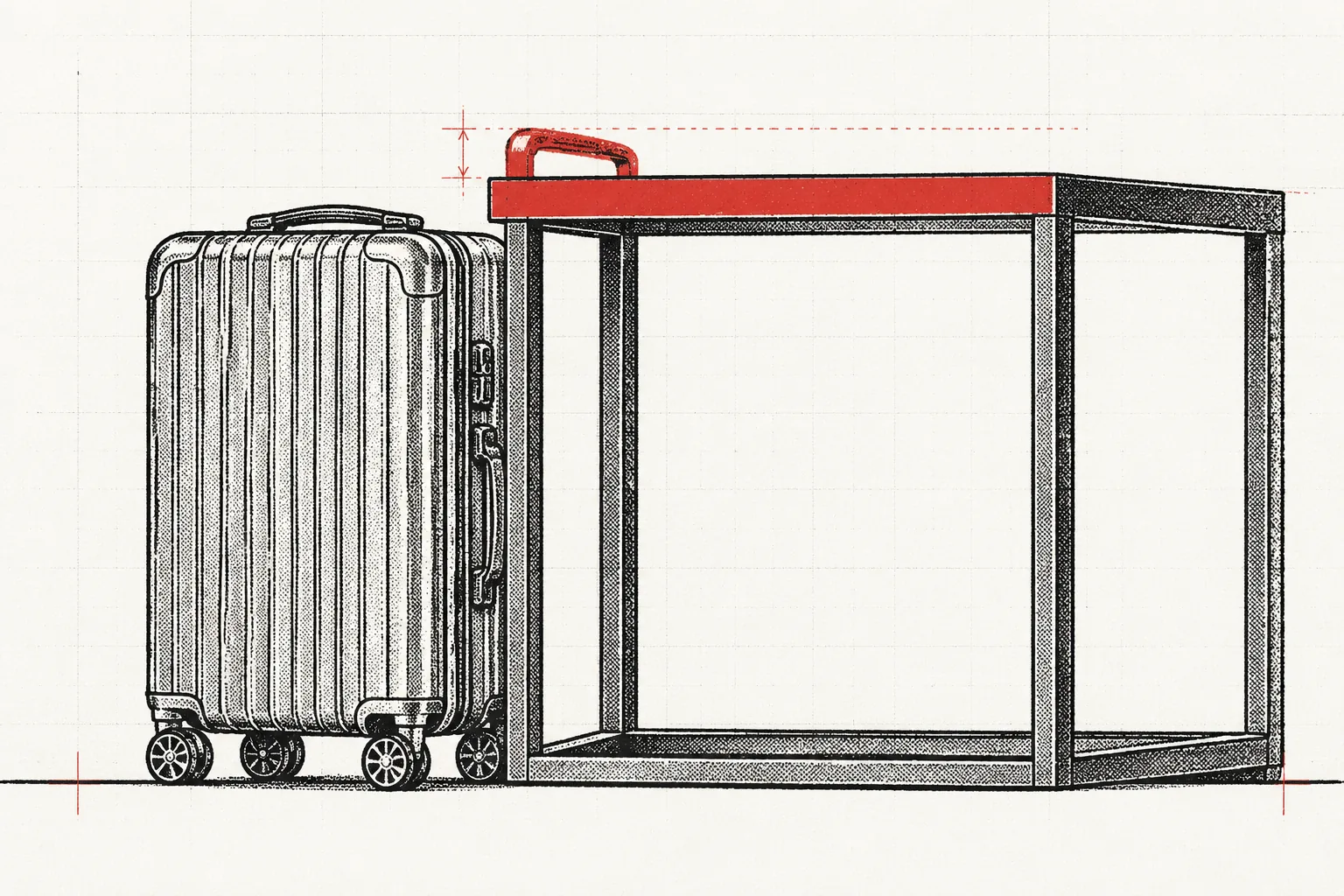
Airline gate agents and airport baggage sizers measure the complete external envelope of a carry-on case, not merely the interior packing volume. Rigid metal measuring cages at regional boarding gates evaluate absolute extremities: from the bottom contact surface of the caster wheels to the apex of the retracted trolley handle, including any side handles, hinges, or protective bumpers. Luggage that appears compliant based on body dimensions alone often fails gate checks because consumer specifications frequently omit these external fixtures.
The primary points of physical interference are caster assemblies and external grab handles. A hard shell measuring 500 mm in body height will readily exceed the common 560 mm airline vertical ceiling once 55 mm to 65 mm dual-spinner wheels and a top handle profile are installed. On the lateral axes, surface-mounted aluminium corner guards, heavy-duty zipper tracks, and molded side feet add crucial millimeters that can push a nominal 350 x 220 mm shell past the rigid 360 x 230 mm gate sizer thresholds enforced by Southeast Asian carriers.
For luggage brand product managers, avoiding gate rejections requires engineering hardware integration during the tooling phase rather than treating wheels and handles as post-molding add-ons. Recessing wheel wells into the lower chassis and sinking handle housings into the shell profile preserves packing volume while keeping total outer clearance within carrier bounds. Through 100% in-house mould making, shell geometry, finished tare weight, and total exterior dimensions are calibrated directly to customer technical drawings before volume production begins.
Airport Sizer Boxes and Cabin Luggage Enforcement in Indonesian Terminals
Carry-on dimensional compliance across Indonesian airports is verified through rigid steel sizer frames positioned at terminal check-in counters and boarding gates. Major hubs such as Jakarta (CGK) and Bali (DPS) routinely cross-examine carry-on bags against regional baseline parameters—commonly 56 x 36 x 23 cm with a 7 kg mass cap at full-service counters, and the tighter 40 x 30 x 20 cm at Lion Group counters. Ground staff evaluate the entire exterior envelope, meaning top carry handles, corner guards, and spinner wheel assemblies must clear the metal cage without force.
Enforcement stringency varies significantly between narrow-body mainline aircraft (such as Airbus A320 or Boeing 737 fleets) and regional turboprop operations (such as ATR 72 equipment serving remote airstrips). Turboprop overhead bins offer severely constrained depth and curvature, leading ground crews to mandate gate-checking for pieces that otherwise pass mainline jet sizers. Brands developing travel goods for Indonesian routes must account for these fleet-dependent discrepancies when establishing catalog specifications.
For luggage product managers, managing physical clearance during mould development is critical. Shell tooling must account for wheel-stem heights and trolley handle housing profiles to keep total envelope dimensions within strict envelope limits. At PT DJI Travel Products Indonesia, finished case dimensions and exterior clearances are confirmed per order against customer technical drawings, ensuring physical samples and production runs align precisely with gate-sizer geometry.
Cabin Baggage and Personal Item Parameters Across Jet and Regional Aircraft
Indonesian domestic air routes operate across varied fleet configurations, primarily splitting between narrow-body passenger jets (such as the Airbus A320 and Boeing 737) and regional turboprops like the ATR 72. On narrow-body aircraft, overhead bins accommodate standard rollaboard luggage matching the regional standard of 56 x 36 x 23 cm and a 7 kg gross weight limit. In contrast, ATR overhead compartments feature severely restricted vertical clearance and depth, precluding standard 20-inch hardshell cases and necessitating gate-side baggage delivery even when items meet standard airline carry-on policies.
Personal item rules require secondary bags—such as laptop cases, briefcases, or small backpacks—to fit entirely beneath the seat directly in front of the passenger, typically capped between 40 x 30 x 10 cm (AirAsia's smaller-bag allowance) and 40 x 30 x 15 cm depending on the carrier. On regional turboprop operations, under-seat space is further constrained by lower structural seat rails and narrower pitch, leaving negligible tolerance for expanded soft bags or rigid structures.
For luggage product managers developing carry-on collections for Southeast Asian routes, engineering must accommodate the airline baggage sizer, which measures the complete outer envelope including spinner wheels, top handles, and side bumpers. Because regional carriers strictly enforce the 7 kg limit at check-in scales, finished case tare weight and shell volume must be verified per technical drawing during prototyping to ensure travelers retain sufficient functional packing capacity.
Specifying 20-Inch Mould Dimensions for Regional Cabin Sizing Compliance
Luggage brands developing 20-inch carry-on collections for Indonesian and Southeast Asian carriers must account for total external dimensions, not just the bare shell height. Airlines measure cabin baggage against strict volume boxes—most commonly 56 x 36 x 23 cm—which include spinner wheels, corner protectors, top grab handles, and side feet. Because airlines operating smaller regional turboprop routes often impose tighter limits than mainline jet routes, brands designing for cross-fleet compliance must engineer moulds that reserve sufficient vertical tolerance for mechanical component integration.
At our 10,000 m² plant in Bogor, West Java, mould designs are handled with 100% in-house mould making to tightly control the shell's height-to-clearance ratios. When configuring tooling for our two 1,500-tonne injection machines or sheet vacuum-forming stations, shell blanks are sized to accommodate wheel assemblies that undergo our standard 4-wheel mileage test (8 km + 2 km + 2 km with wear ≤ 2 mm) without exceeding the 56 cm regional ceiling. Recessed wheel casters and low-profile trolley housings allow product managers to maximize internal packing volume while preserving the necessary outer envelope.
Finished case tare weight and shell volume are confirmed per order according to each customer's technical drawings. Whether engineering lightweight PP injection bodies or aluminum frame builds with 10–12 μm anodic oxide film, our engineering team works directly from client dimensional briefs with an MOQ of 100 pieces per SKU. This ensures every production run satisfies airline gate checks while maintaining structural integrity under our standard 40 kg static load requirements for carry-on shells.