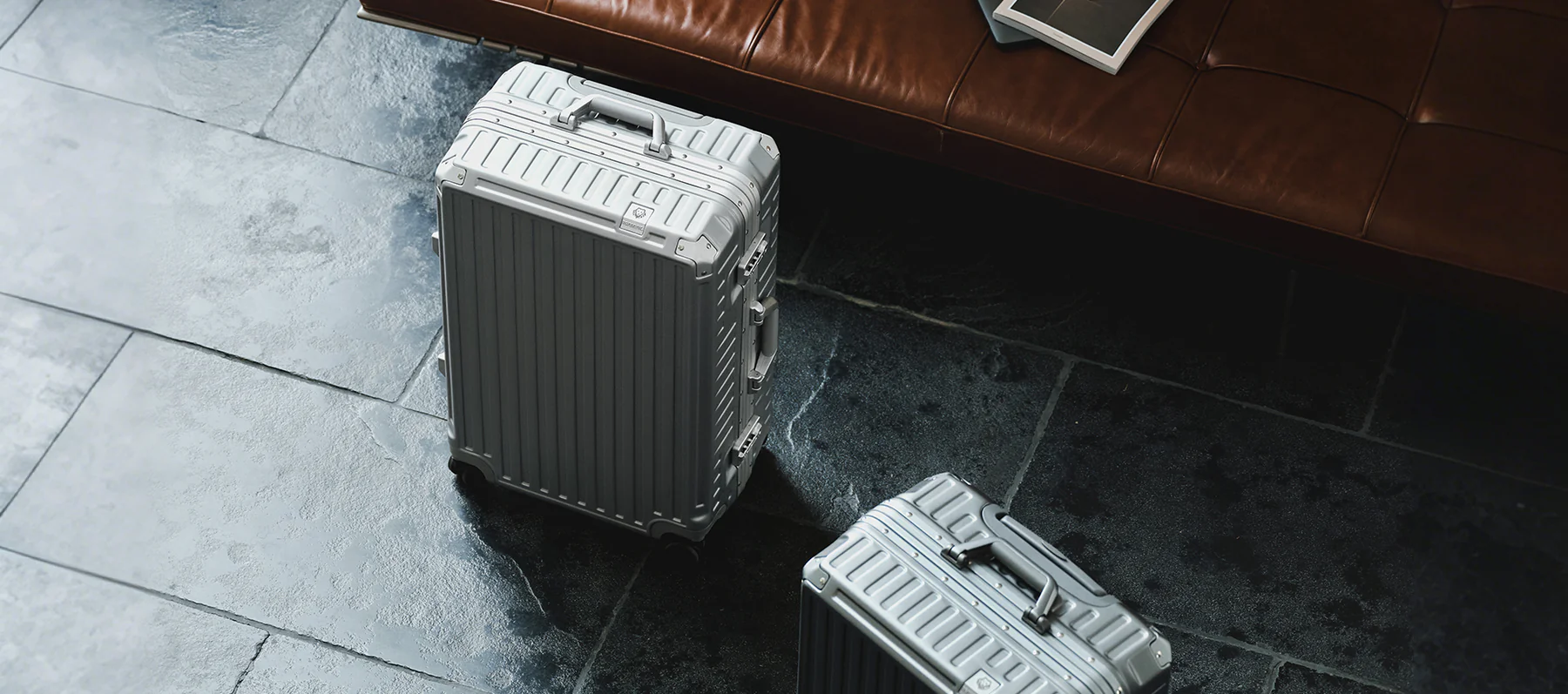
Small-batch runs at this scale start with sampling in 7 to 15 working days, then move to bulk production in 25 to 55 days from deposit and sample confirmation. The 100-piece threshold applies to each color-and-size combination, so a typical trial order with two colors and two sizes totals 400 pieces across four SKUs.
The plant ships over 100 forty-foot containers a year to China, Indonesia, the United States, Germany, Australia, and the United Kingdom. Materials in use include polypropylene, Covestro polycarbonate, ABS+PC, ABS, 5052 and 6061 aluminum framing, full-aluminum shells in 5052 and 6061, and textile panels.
Why Most Factories Set Higher Minimums
Large-scale luggage plants optimize for long production runs because switching colors or moving to a different SKU incurs downtime. Injection machines must be purged, assembly jigs recalibrated, and quality checkpoints reset. A line that runs 5,000 units of one color recovers the setup cost across thousands of pieces. At 100 pieces the setup overhead becomes a larger share of the total cycle, so factories with tight production schedules often decline the order or raise the price to compensate.
Tooling availability is the second constraint. If a factory borrows molds from a shared tool bank or leases capacity from an external mold shop, scheduling a short run competes with larger clients who book months in advance. Factories that own their tooling can slot small batches between major orders without waiting for mold returns or approval from a third party.
Material purchasing adds a third layer. Bulk resin orders ship in 25-ton truckloads; ordering two tons for a small run either forces the factory to carry leftover inventory or pay a premium for smaller shipments. Plants that maintain diverse SKU portfolios absorb small material orders into their existing stock rotation, which removes the penalty.
How the 100-Piece Count Works
The MOQ of 100 pieces per SKU applies to each distinct combination of color and size. A carry-on model offered in black and silver, with 20-inch and 22-inch variants, defines four SKUs: black 20-inch, black 22-inch, silver 20-inch, and silver 22-inch. The minimum order becomes 400 pieces total.
A brand testing a single colorway in one size meets the threshold with 100 units. A brand launching two colors in three sizes commits to 600 pieces across six SKUs. The structure encourages consolidation around fewer combinations when testing demand, then expansion once reorder velocity justifies broader assortment.
Example: Two-Color, Two-Size Launch
- Matte black, 20-inch: 100 pieces
- Matte black, 22-inch: 100 pieces
- Brushed silver, 20-inch: 100 pieces
- Brushed silver, 22-inch: 100 pieces
- Total: 400 pieces
Aluminum Framing and Small-Batch Feasibility
Aluminum carry-ons use extruded profiles for the perimeter frame, which are cut to length, drilled for rivet holes, and assembled around the polycarbonate or ABS shell. The frame components themselves do not require dedicated tooling for every SKU; the same extrusion profile serves multiple sizes, and the shell molds define the final dimensions.
Rivet placement and hinge attachment are the steps most sensitive to size variation. Each size requires fixture adjustments so that rivet alignment matches the hole pattern in the shell. At 100 pieces the fixture setup is completed once and the line runs continuously until the batch is finished. Full-aluminum shells, built from stamped and welded panels in 5052 or 6061 alloy, follow the same principle: the stamping dies remain in service across batches, and only the surface finish or anodizing color changes between orders.
The frame-and-shell construction method makes aluminum carry-ons more forgiving for small batches than fully injection-molded cases, where every part of the tooling must be dedicated to one design. A frame-based design reuses the extrusion profile, the hinge hardware, and the wheel mounts, leaving only the shell mold and corner protectors as SKU-specific components.
Batch Size and Production Trade-Offs
| Batch Size |
Tooling Priority |
Color Changeover |
Unit Cost Structure |
Lead Time |
| 100–300 pieces |
Slotted between larger runs; mold availability depends on production calendar |
Single purge cycle; minimal material waste |
Setup cost distributed over fewer units; higher per-piece share |
25–55 days from deposit and sample confirmation |
| 500–1,000 pieces |
Scheduled in advance; mold reserved for the batch window |
One or two color switches feasible within the run |
Setup cost begins to dilute; economy of scale starts to apply |
30–60 days; longer runs may extend the window |
| 3,000+ pieces |
Dedicated production slot; tooling locked for the duration |
Multiple color runs managed in sequence with minimal downtime |
Setup cost negligible per unit; pricing reflects material and labor only |
45–70 days; container loading and export documentation add time |
Small batches carry higher per-piece costs because setup hours are amortized over fewer units, but they allow brands to test market response before committing capital to deep inventory. Mid-size batches balance cost efficiency with inventory risk. Large batches achieve the lowest unit cost but require confident demand forecasting and warehouse capacity.
Timeline from 100-Piece Trial to Reorder
A buyer ordering 100 pieces to validate a new aluminum carry-on design begins with a sampling phase. The factory produces prototypes in 7 to 15 working days, depending on whether the design requires new tooling or adapts an existing mold. Once the sample is approved and the deposit is received, bulk production starts and completes in 25 to 55 days.
If the design requires a new mold, the total timeline extends to approximately 80 days: 10 days to complete the mold, 25 days to ship the mold to the plant and conduct trial assembly, and 45 days for the first production run. Subsequent reorders using the same mold skip the tooling phase and return to the 25-to-55-day bulk cycle.
Reorders below 100 pieces per SKU are evaluated case by case. If the original mold remains in the plant and the production calendar has an opening, the factory may accept a smaller quantity. If the mold has been archived or the line is fully booked, the 100-piece minimum applies.
Sample Order with New Tooling
- Day 0: Deposit received, design and mold specifications confirmed
- Day 10: Mold completed
- Day 35: Mold delivered to plant, trial shells produced and inspected
- Day 80: Bulk production finished, ready for shipment
Reorder with Existing Tooling
- Day 0: Order placed, sample confirmation completed
- Day 25–55: Bulk production finished, ready for shipment
How Small Orders Are Treated in a 75-Person, 4-Line Plant
A factory with 75 employees and 4 production lines is large enough to maintain consistent quality control and handle parallel SKU runs, but small enough that every order receives direct attention from the production manager. The plant does not operate a separate low-priority line for small batches. All orders move through the same injection machines, the same assembly stations, and the same final inspection protocol.
Owning the molds in-house removes the risk that a small order will be delayed because the tooling is borrowed by another client or awaiting return from a shared mold bank. The plant schedules small batches into open slots on the production calendar, typically between larger runs or during periods when a line would otherwise sit idle waiting for the next container shipment to fill.
The 80,000-unit monthly output distributes across multiple clients and SKUs, so the lines are accustomed to frequent changeovers. A 100-piece order does not disrupt the rhythm; it occupies the line for a few hours to a day, depending on the complexity of the assembly, then makes way for the next SKU in the queue.
Frequently Asked Questions
Can I order 100 aluminum carry-ons if I'm testing a new brand? Yes. The 100-piece minimum per SKU is designed for brand launches and market tests. A single-color, single-size order meets the threshold at 100 units. If you plan to test two colors, the total becomes 200 pieces across two SKUs.
What is the difference between MOQ for a new mold versus an existing mold? The MOQ remains 100 pieces per SKU in both cases. The difference is lead time: a new mold adds approximately 35 days to the production cycle for mold fabrication and trial assembly, while an existing mold allows production to begin immediately after sample confirmation.
How do I know the factory won't prioritize larger clients over my small order? The plant operates 4 production lines with a total monthly output of 80,000 units, which means multiple orders run in parallel throughout the month. Small batches are scheduled into the production calendar alongside larger runs rather than queued separately. Owning the tooling in-house eliminates delays from external mold scheduling, and the 75-person team size ensures that production coordination does not get lost in a large bureaucracy.
What happens if I need to reorder fewer than 100 pieces? Reorders below the 100-piece minimum are considered on a case-by-case basis. If the original mold is still active in the plant and the production schedule has capacity, the factory may accept the smaller quantity. If the mold has been archived or the lines are fully scheduled, the standard 100-piece MOQ applies.