Full Aluminum Luggage Manufacturer
↓
↳
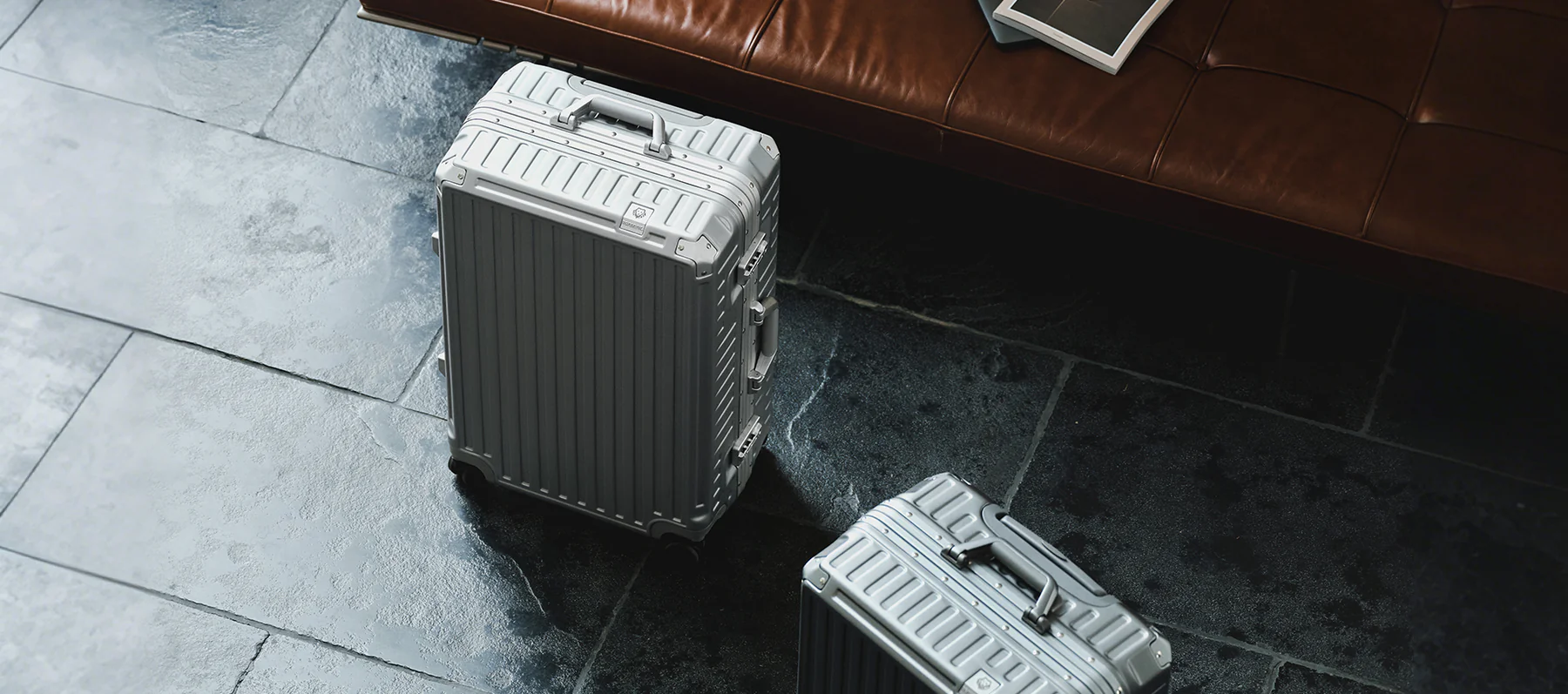
All-metal 5052/6061 aluminium-magnesium alloy suitcases with riveted shells, anodised finishes, and SilentMove spinner wheels — built in Bogor, Indonesia.
All-metal 5052/6061 aluminium-magnesium alloy suitcases with riveted shells, anodised finishes, and SilentMove spinner wheels — built in Bogor, Indonesia.
The creation of our aluminium luggage begins with raw metal sheets, fundamentally differing from the injection-moulded processes used for polycarbonate cases. At our Bogor facility, upper-tier aluminium alloy sheets are subjected to massive hydraulic presses that stamp the flat material into precise, contoured shell halves. Crucially, the iconic parallel rib pattern is not applied afterward; it is formed entirely during the very same press stroke that creates the shell’s overall curvature. This single-stroke stamping technique ensures uniform structural integrity across the entire surface. These engineered grooves are far more than a cosmetic choice; they are essential for structural dynamics. Because a metal sheet lacks the inherent flexural memory and thick-walled rigidity found in standard polymer construction, the deep ribs act as continuous strengthening beams, preventing the broad flat surfaces from oil-canning or denting under heavy transit loads. Before the production line ever begins its cycle, critical parameters such as the raw sheet thickness and the exact millimeter depth of the rib profiles are strictly confirmed per each client order to meet specific market durability requirements.
Once the ribbed front and rear shells are perfectly stamped, they must be securely united to form a cohesive, impenetrable vault. The two halves meet at a robust, heavy-duty aluminium frame, locked together by a densely riveted perimeter that distributes impact stress evenly along the entire edge. Because the most vulnerable points on any suitcase are its extremities, the chassis is further fortified with separate, solid aluminium corner guards, meticulously riveted into place over the stamped shell to absorb the brunt of harsh baggage-handling drops. Our assembly floors are currently optimized to produce a vast array of sizes, seamlessly shifting from standard 20-inch cabin carry-ons to massive 28-inch check-in trunks without sacrificing precision. Backed by an extensive network of automated riveting stations and skilled technicians, the factory maintains a formidable production capacity of 80,000 units per month. This high-volume output ensures that enterprise brands and global retail partners receive their shipments strictly on schedule, guaranteeing a continuous supply of resilient, perfectly aligned metal cases.
When engineering upper-tier travel cases, the choice between 5052 and 6061 aluminium-magnesium alloys is never a simple either-or scenario; rather, both materials are strategically deployed within the very same shell to maximize overall structural integrity. The 5052 alloy is specifically chosen for the main formed body sheets because its superior formability allows it to be deep-drawn and pressed into complex, signature grooved patterns without experiencing surface cracking, while concurrently offering exceptional baseline corrosion resistance against moisture and salt. Conversely, the 6061 alloy is subjected to rigorous heat treatment processes to achieve a significantly higher yield strength. This makes 6061 the mandatory metallurgical choice for crucial load-bearing and impact-prone components, such as the extruded internal frame sections, the reinforced external corner guards, and the telescopic trolley tubes. By intelligently combining these two distinct material profiles, manufacturers create a resilient hybrid architecture that readily absorbs sudden kinetic energy through the slightly more ductile 5052 external panels, while relying entirely on the rigid 6061 skeleton to prevent catastrophic crushing during heavy transit.
For bulk purchasers and brand procurement teams, understanding this highly specific alloy mix is absolutely crucial because it represents a precise technical specification rather than just another layer of superficial marketing rhetoric. The differing microstructures of these two metals directly influence secondary manufacturing processes, particularly during the surface finishing phase. Achieving a perfectly uniform 10–12 μm anodic film requires carefully calibrated chemical dwell times to ensure that the dyed colors match seamlessly across the chemically distinct alloy surfaces. Furthermore, this deliberate combination dictates the long-term repair behavior of the luggage; for instance, dented 5052 side panels can often be carefully hammered back into proper alignment by skilled service technicians, whereas a bent 6061 structural frame typically shatters or weakens upon bending, requiring complete component replacement. This robust dual-alloy construction ultimately guarantees reliable performance across extreme environmental shifts, maintaining tight dimensional stability throughout a remarkably demanding operating range of −40 to 120 °C. Because these variables are so critical, the exact alloy selection per individual part and the corresponding sheet thickness are meticulously confirmed per order to meet specific payload needs.
In the realm of full-aluminium luggage manufacturing, the exterior finish is never a superficially applied paint, but rather a robust anodic oxide layer grown directly from the underlying substrate. By employing a meticulous electrochemical process within our specialized facilities, we cultivate a protective film measuring exactly 10–12 μm in thickness. Because this microscopic structure remains highly porous before the final sealing stage, it accepts dyes beautifully within the anodising bath, allowing the colour to become an integral structural component of the metal rather than a fragile topical coating. Clients can specify any of our eight distinct AURA shades, ensuring a sophisticated aesthetic that meets strict corporate branding guidelines. Maintaining exact visual consistency across a large-scale manufacturing environment requires rigorous quality control; therefore, bath colour matching across an entire production run is thoroughly confirmed and documented per individual order. This guarantees that whether a brand requests a vibrant crimson or a subdued titanium hue, the resulting fleet of suitcases will exhibit perfectly uniform aesthetics.
Beyond establishing a upper-tier aesthetic, this 10–12 μm anodic layer fundamentally enhances the resilience of the suitcase against the rigorous demands of global travel. The anodised surface is specifically engineered to defend against environmental degradation, successfully passing the stringent 16-hour neutral salt spray test defined by the comprehensive ISO 9227 and ASTM B117 international standards. Under these punishing laboratory testing parameters, the finish is certified to exhibit no more than three corrosion points, with each isolated point strictly confined to an area within 1 mm². Furthermore, the hardened exterior effectively resists routine abrasion from mechanical airport conveyor belts and significantly combats colour fading caused by prolonged exposure to ultraviolet radiation in transit. However, it is essential for commercial buyers to understand the physical limitations of this advanced electrochemical treatment; while exceptional at preventing surface-level wear, deep traumatic gouges or severe structural scratches will penetrate the oxide barrier and inevitably expose the bright, bare aluminium alloy underneath. Despite this limitation, the enhanced durability profile ensures the product retains its sophisticated character across continents.
When sourcing full-aluminum luggage within the standard 20-inch to 28-inch size range, brands must understand exactly what a metal body means for customers after the sale. Unlike polycarbonate which can crack or shatter under extreme environmental stress, aluminum alloy handles severe temperature fluctuations without structural failure. This resilience is verified through a rigorous 90 cm drop test conducted immediately after the case is subjected to 4 hours at −12 °C, ensuring the shell maintains its integrity in freezing aviation cargo holds. Furthermore, each structural design must pass a demanding 900 mm loaded drop onto a solid steel plate to simulate severe baggage handling abuse. However, the inherent rigidity of the metal shell introduces a crucial trade-off: aluminum effectively transmits impact forces directly to the corner guards and hinges rather than absorbing them through flex. This means the overall durability of the luggage relies heavily on the reinforcement of these specific hardware nodes, dictating how the case survives frequent travel through major transit hubs from Heathrow to Haneda.
The reality of daily service is that aluminum cases will acquire character through dents, but these deformations remain strictly local and can often be pressed back into shape rather than requiring a complete panel replacement. Because the entire framework is mechanically fastened, a damaged case can be easily re-riveted by service centers, significantly extending the lifecycle of the product. Structural strength is further validated by a punishing 4 h static load test, where the frame must support a continuous weight of 40 kg or 60 kg depending on the specific body height of the model. To support long-term fleet maintenance, your specific repair policy and spare-part availability are comprehensively confirmed per order before manufacturing begins. By ensuring that replacement wheels, locks, and corner protectors are readily accessible, B2B clients can confidently guarantee dependable after-sales support for their upper-tier luggage collections, turning the inevitable wear and tear of global transit into an acceptable, manageable aspect of ownership.
When an enterprise buyer prepares to quote a full-aluminium programme, precise specifications dictate the entire trajectory of the project. A comprehensive initial brief must meticulously outline the core manufacturing requirements, allowing our seasoned engineers to align global production capabilities with the brand's ultimate commercial vision. This meticulous level of technical detail allows our dedicated team to integrate the project seamlessly into our extensive Luggage ODM workflow.
To initiate an accurate and competitive quotation, Tier 1 partners must provide a highly detailed specification sheet that covers both structural components and aesthetic preferences. The essential parameters include:
Standard commercial agreements establish a strict MOQ of 100 pcs per SKU, logically counted per colour multiplied by size. The standard development timeline typically requires 7–15 working days for initial sampling, while bulk manufacturing spans between 25–55 days. Implementing a completely new tool extends the production schedule by approximately 80 days total, which systematically breaks down into 10 days for cutting, 25 days for transit and fitment, and 45 days for full-scale production runs. Before finalizing any formal agreement, critical variables including exact sheet thickness, inner lining weight, strict inspection AQL values, tiered pricing structures, international payment terms, specific trade terms, and ultimate mould ownership are explicitly confirmed per individual order. To submit your complete technical pack and request a formal project review, please visit our Contact page.
How is a full-aluminium case different from a case with an aluminium frame? A full-aluminium unit utilizes a stamped 5052 or 6061 ribbed sheet secured by a riveted perimeter. A frame build pairs an extruded 5052 or 6061 profile with a Covestro PC or ABS+PC shell. Both approaches function reliably across temperatures spanning from −40 to 120 °C. All other material specifications are confirmed per order.
Does a metal body dent, and can a dent be repaired? Our standardized testing protocol involves a 900 mm loaded drop directly onto a solid steel plate. The stamped metal exterior absorbs shock and might physically deform under significant external force, yet it avoids shattering. Repair viability always depends on the deformation severity. All additional structural guarantees or maintenance protocols are confirmed per order.
What keeps the anodised colour from fading or corroding? Surface protection is maintained by an applied 10–12 μm anodic film. This finish passes a 16 h neutral salt spray test meeting ISO 9227 and ASTM B117 standards, resulting in ≤3 corrosion points where each is ≤1 mm². Any other specific anti-corrosion treatments or alternative coating requirements are always confirmed per order.
Is a full-aluminium case heavier than a polycarbonate one? Yes, full aluminium construction is generally heavier than polycarbonate. We manufacture the AURA Collection using 5052 and 6061 aluminium, providing structural rigidity across the twenty, twenty four, twenty six, and twenty eight inch sizes. Exact weights naturally differ based on the selected dimensions, but all specific weight figures remain confirmed per order.
What is the MOQ and how is it counted? The minimum order quantity is established at exactly 100 pcs per SKU. This figure is calculated strictly per colour multiplied by size. Our AURA Collection currently offers eight distinct colours to choose from. Any alternative quantity requirements or special batch requests beyond these standard parameters will be thoroughly reviewed and confirmed per order.
How long does sampling and bulk production take? Standard sampling requires 7 to 15 working days, while bulk production needs 25 to 55 working days. Developing a new tool takes approximately 80 days total, divided into 10 days for cutting, 25 for transit and fitment, and 45 for production. Further timeline adjustments and specific delivery logistics are confirmed per order.
