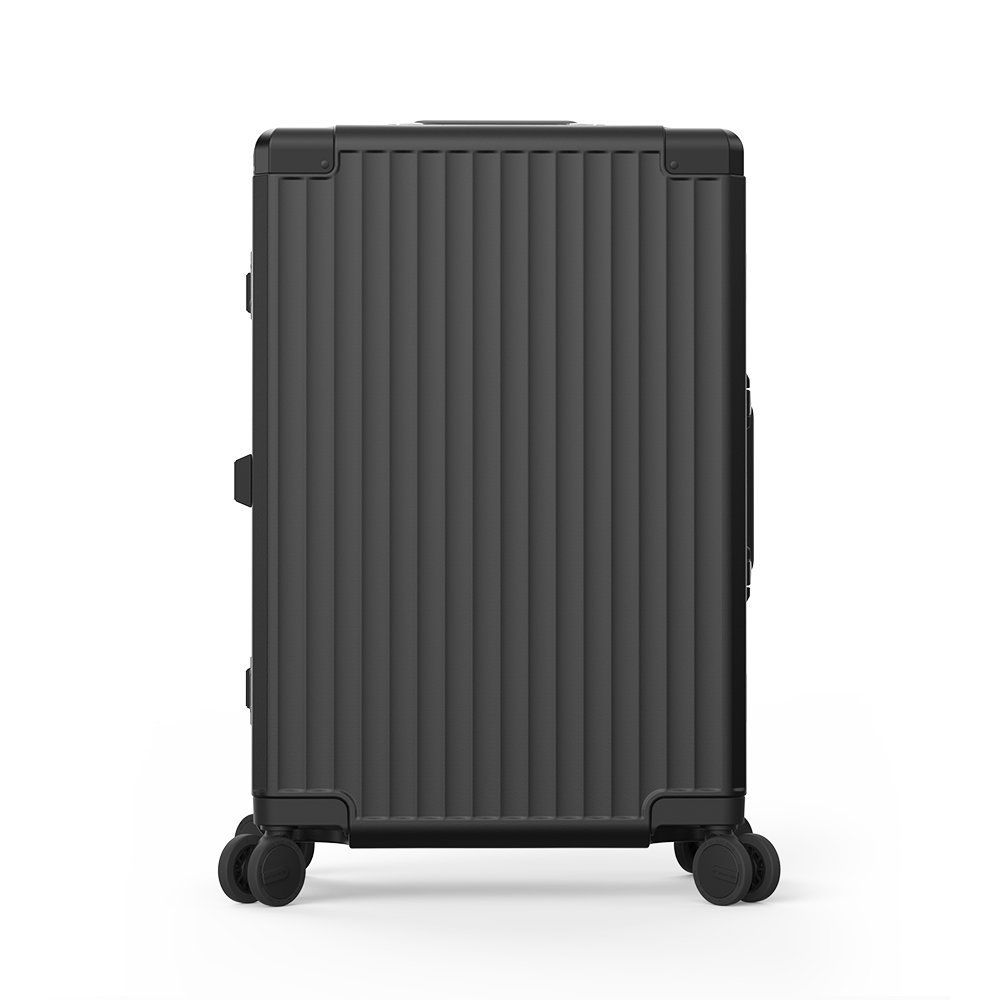
TL;DR: Zipperless 5052/6061 aluminium frame vs YKK zipper closure
When luggage brands and B2B importers plan a hard-shell collection, the perimeter closure — extruded 5052/6061 aluminium frame versus YKK coil or woven zipper — is the single structural decision that shifts a suitcase from a mid-market travel line into a premium flagship tier. At DJI Luggage (PT. DJI Travel Products Indonesia · NIB 0710250022508 · KBLI 15121) in Bogor, West Java, Indonesia, we manufacture both closures across our 80,000-unit/month facility (two 1,500-tonne injection machines, 100% in-house mould making, group manufacturing luggage since 2011, Indonesia factory operating since 2025). Both configurations run at MOQ 100 units per SKU, 7–15 working days sampling, and 25–55 days bulk production.
| Comparison Dimension | Zipperless Aluminium-Frame Luggage | YKK Zippered Hard-Shell Luggage |
|---|---|---|
| Perimeter Closure Structure | Extruded 5052 / 6061 aluminium alloy profile bent and riveted to shell; tongue-and-groove seal | Heavy-duty YKK zipper tape stitched to shell perimeter with optional 2" gusset expansion |
| Locking Mechanism | Dual integrated TSA-compatible mechanical latch locks mounted on the metal frame | Single recessed TSA combination lock capturing two custom YKK zipper pullers |
| Compatible Shell Polymers | Covestro PC, ABS+PC composite, or full 5052/6061 aluminium body | Covestro PC, injection-moulded PP, ABS+PC, or plain ABS |
| Case-Mouth Rigidity & Security | Highest crush resistance (Brinell hardness ≥ 40 HWB under ISO 6506 / ASTM E10); puncture-proof perimeter | Flexible perimeter that absorbs overpacking stress; allows expandable volume |
| Baseline Weight (20" / 24" / 28") | 20": 4.38 kg (39 L) · 24": 4.88 kg (60 L) · 28": 5.2 kg | Typically 0.35–0.60 kg lighter per case than equivalent frame models |
| Relative Unit FOB Cost | Higher BOM cost (extruded alloy profile, anodising bath, dual TSA latches, riveting labour) | Lower BOM cost; fastest assembly cycle time for high-volume retail and nested sets |
1. Structural mechanics: how each closure behaves in airport handling
In airline baggage handling, the perimeter opening (case mouth) experiences two opposing forces: internal burst pressure from overpacked garments and external shear impact when a loaded trolley case hits a conveyor chute or concrete apron. On a zippered hardshell suitcase, the YKK zipper tape acts as a flexible hinge. When the suitcase lands on a corner during our 900 mm loaded drop test onto a solid steel impact plate (or after four hours of cold conditioning at −12 °C), the polymer shell flexes and the fabric tape stretches slightly to dissipate energy.
On an aluminium-frame suitcase, the extruded 5052 or 6061 aluminium channel forms a rigid structural spine around both halves of the shell. Because there is no fabric tape to puncture with a ballpoint pen, zipperless frame cases offer superior anti-theft security and stack rigidity (tested under 40 kg and 60 kg continuous four-hour static loads). However, that rigidity requires proper metallurgy: if a supplier uses under-hardened scrap aluminium or spot-welds the corners, a single corner drop will warp the tongue-and-groove channel so the latches cannot close. At our Bogor factory, every 5052/6061 frame is cold-bent to radius, riveted (never welded), anodised to a 10–12 μm oxide film, and verified to at least 40 HWB Brinell hardness (ISO 6506 / ASTM E10) alongside a 16-hour neutral salt spray test (ISO 9227 / ASTM B117).
2. Weight, expandability and airline cabin compliance
For travellers flying strict carry-on weight limits (such as 7 kg cabin allowances on Asia-Pacific and Australian carriers), weight is the primary trade-off. An extruded 5052/6061 frame, four metal corner guards, and dual mechanical TSA latch housings add roughly 400–600 grams compared with a YKK zipper assembly. In addition, an aluminium frame has a fixed internal volume (39 L on our 37.6×22.6×58.4 cm 20" carry-on; 60 L on our 37.6×30.5×65.5 cm 24" medium checked case), whereas a YKK zippered suitcase can incorporate a secondary expander zip that adds 15–20% packing volume.
3. How travel brands combine both closures in one product line
Rather than choosing one closure exclusively, established DTC travel brands, department stores, and regional distributors typically split their catalogue into two price tiers built on shared hardware:
- Core Volume Tier (YKK Zippered PC, PP, or ABS+PC): Captures 65–75% of unit volume across single 20" cabin cases and 3-piece nested sets (20" + 24" + 28" packed 3-in-1 per export carton), fitted with YKK zippers and SilentMove 360° spinner wheels.
- Halo / Executive Tier (Zipperless 5052/6061 Aluminium Frame or Full Aluminium): Positioned 30–50% higher at retail to anchor brand prestige, using our proven Voyager or Captain ODM frame structures or custom OEM moulds.
Both tiers share the same SilentMove 360° spinner wheels (tested for 8 km on a cement drum plus 4 km on a cleated conveyor with wear ≤ 2 mm), multi-stage telescopic handles, and six-point private-label branding. Request a side-by-side FOB Jakarta or EXW Bogor quotation via our contact page.
This is one of five breakdowns on shell material. For the full picture — ABS, ABS+PC, PC, PP and aluminium side by side — start with material choices for hard shell luggage.
Questions buyers ask about aluminium-frame vs zipper luggage
Is an aluminium-frame suitcase more durable than a zippered suitcase? An aluminium-frame suitcase (5052/6061 alloy ≥ 40 HWB) eliminates zipper tooth separation and slash theft while providing higher crush resistance, whereas a YKK zippered Covestro PC or PP suitcase is lighter and offers optional gusset expansion.
Can we use the same shell mould for both a zippered and an aluminium-frame suitcase? Yes. Many of our ODM polycarbonate and ABS+PC moulds in Bogor can be trimmed and assembled either as a YKK zippered line or as a riveted 5052/6061 aluminium-frame line.
What is the MOQ to order both zippered and aluminium-frame models? MOQ is 100 units per SKU (per colour × size combination) for both closures, with 7–15 working days for sampling and 25–55 days for mass production.
View all