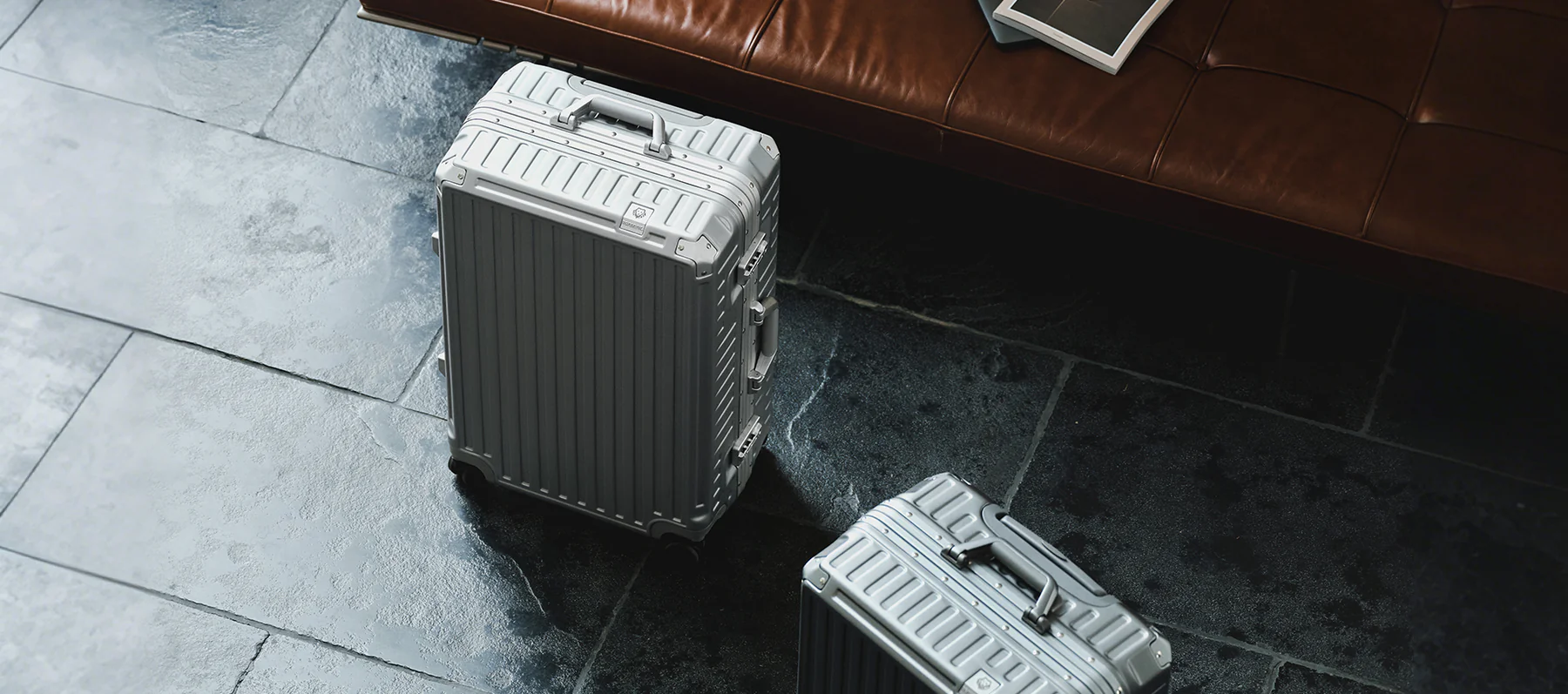
Aluminum Frame Luggage Manufacturer
↓
↳
Zipperless suitcases built with an extruded 5052/6061 aluminium frame riveted to a Covestro PC or ABS+PC shell — manufactured in Bogor, Indonesia at MOQ 100 units per SKU.
Zipperless suitcases built with an extruded 5052/6061 aluminium frame riveted to a Covestro PC or ABS+PC shell — manufactured in Bogor, Indonesia at MOQ 100 units per SKU.
Moving beyond a simple flat band, the structural integrity of our upper-tier luggage relies heavily on a complex extruded 5052 or 6061 aluminum alloy profile. This meticulously engineered cross-section does not merely reinforce the shell; it actively integrates multiple functional zones into a single continuous piece. Specifically, the internal geometry carries a precision-milled step designed to tightly trap the polycarbonate shell edge, eliminating the risk of separation during severe transit shocks. Adjacent to this step, a dedicated channel seamlessly accommodates either a reinforced zipper tape or a rigid latch seat, depending on the closure mechanism chosen. Furthermore, a protruding interlocking lip is machined along the outer edge to perfectly meet the opposite half when the case closes, creating a weather-resistant barrier against dust and moisture. Whether fabricating compact 20-inch carry-on bodies or expansive 28-inch check-in trunks, the raw extrusion is precisely cut and continuously bent to match the exact perimeter of the case. The corner joints are then permanently formed using a continuous riveted attachment along the entire perimeter, with CNC finishing to ensure a seamless, indestructible junction that maintains the structural continuity of the entire perimeter.
Before this intricate framework is permanently riveted or bonded to the main shell, the entire aluminum perimeter undergoes a rigorous surface treatment process to apply a protective anodised film. Maintaining a strict thickness of 10 to 12 μm, this anodic layer is infused directly into the metal surface prior to assembly rather than after, which guarantees uniform corrosion resistance and prevents any raw, untreated edges from being exposed at the joint intersections. This pre-assembly anodising also allows for deep, consistent color penetration that will not chip under the harsh conditions of international baggage handling. Because each travel brand has unique requirements, crucial specifications such as the exact profile wall thickness, the integrated lock brand—such as certified locking modules from YiFeng—and the final metallic colour are rigorously confirmed on a per-order basis. By customizing these parameters, manufacturers confidently balance lightweight maneuverability with the exceptional crush resistance demanded by today’s luxury travel market, ensuring every finished frame performs flawlessly for years.
The sophisticated architecture of modern framed luggage relies on a highly calculated division of labour between two distinct material families to achieve optimal performance during international travel. The main exterior shell utilizes high-impact Covestro PC or a specialized ABS+PC blended compound. This specific polymer selection provides the notably light, deep-drawn body of the suitcase while simultaneously establishing the vibrant, customizable surface colour that brands require for global retail appeal. However, relying solely on flexible plastics for closure integrity forces manufacturers to noticeably increase the overall shell gauge to prevent bending. By integrating a dedicated aluminium frame directly along the mating edges, the structural burdens of the mechanical latch mechanisms and heavy hinge assemblies are entirely transferred away from the polymer. This robust metallic chassis provides critical, unyielding rigidity exactly where a travel case is most frequently abused—the central perimeter seam. Because the frame manages these intense shear forces with absolute ease, the surrounding shell wall can stay significantly thinner than an unframed zipper case would safely allow, reducing overall weight.
This efficient composite methodology contrasts plainly with the distinct engineering requirements of a full-aluminium body. In those purely metallic configurations, engineers must rely entirely on stamped 5052 or 6061 ribbed sheet metal, securely fastened by a heavily riveted perimeter, to establish structural stability and prevent denting. Neither construction approach ranks as inherently superior; rather, they serve entirely different functional and aesthetic thresholds without direct competition. The framed polycarbonate variant specifically excels in fluctuating environmental conditions, maintaining its dimensional stability and impact resistance across a remarkably demanding −40 to 120 °C temperature range. To guarantee this elite level of performance, the exact baseline wall thickness of the polymer shell is always confirmed per order, precisely matching the targeted capacity and load specifications of the commercial client. This meticulous manufacturing calibration ensures the rigid aluminium frame and the lightweight body work in perfect mechanical synergy, delivering a specialized, high-frequency transit enclosure without inheriting the heavier weight penalty of thick alloy panels.
During the assembly of the aluminum frame to the primary luggage shell, fastening precision ultimately determines the overall structural integrity. We utilize a meticulously calculated rivet pitch, placing each fastener at exact mathematical intervals along the perimeter. This precise placement ensures that kinetic loads are distributed evenly across the entire frame rather than concentrated at vulnerable stress points, effectively preventing micro-fractures during heavy international transit. Once the riveting process is fully complete, a specialized industrial sealant is expertly applied along the entire seam. This vital sealing step creates a robust, watertight barrier that completely blocks moisture ingress, protecting interior contents from rain. To guarantee the rigidity of this critical junction, the completed case mouth undergoes strict metallurgical evaluation. We systematically verify that the aluminum alloy retains a minimum hardness of 40 HWB on the Brinell scale, strictly adhering to the rigorous testing protocols outlined in ISO 6506 and ASTM E10. Achieving this ≥40 HWB metric ensures the frame will not warp when the luggage is fully packed and subjected to external compressive forces.
A frame passing initial assembly must then survive destructive physical evaluations continuously managed through our rigorous IQC, IPQC, and OQC quality control stages. To catch any concealed weaknesses in frame integration, fully assembled units undergo a brutal 900 mm loaded drop directly onto a solid steel plate, simulating the most severe mishandling by commercial baggage operators. Furthermore, we test comprehensive thermal resilience by chilling the luggage for 4 hours at a freezing −12 °C, followed immediately by another punishing 90 cm drop to ensure the cold frame does not shatter or separate from the shell. Environmental durability is equally scrutinized; all metal components must endure a continuous 16-hour neutral salt spray test in strict accordance with ISO 9227 and ASTM B117 standards. To pass this intensive corrosion assessment, the frame must exhibit extreme chemical resilience, allowing for ≤3 corrosion points with each blemish measuring ≤1 mm². By rigorously enforcing these checkpoints, we guarantee every piece of aluminum frame luggage offers uncompromising longevity.
Initiating a successful production run in Asia begins with a comprehensive technical specification. When structuring an aluminium-frame programme, buyers must define precise requirements to ensure the final product meets their market positioning. Essential metrics confirmed per order include the exact wall thickness, interior lining weight, chosen lock brand, and acceptable AQL values. Financial and legal parameters such as tiered pricing structures, payment terms, trade terms, and ultimate mould ownership are also cemented before manufacturing commences.
For tailored guidance on structuring these complex specifications or initiating a new development cycle, procurement teams can reach out through our contact portal to speak directly with an engineering specialist within 24 hours.
How is the frame fixed to the shell, and can it be repaired? The extruded 5052/6061 aluminium frame utilizes a secure riveted attachment along the entire perimeter joining directly to the case mouth rated at ≥40 HWB according to ISO 6506 / ASTM E10 standards. Due to the permanent nature of the rivets, specific repair terms are confirmed per order for individual warranty claims.
Does the aluminium frame add much weight to a 20-inch case? The extruded 5052/6061 aluminium provides necessary structural strength without excessive mass, although exact product dimensions and the final wall thickness are confirmed per order. Furthermore, the metal features an anodised 10–12 μm finish, successfully passing a 16 h salt spray ISO 9227 / ASTM B117 test with ≤3 corrosion points each ≤1 mm² limit.
What keeps the frame and shell from separating on a drop? The extremely strong riveted attachment completely prevents separation during severe impacts. The secure assembly survives a 900 mm loaded drop onto a solid steel plate without failing. It also maintains structural integrity during a 90 cm drop after 4 h at −12 °C. All other environmental metrics are confirmed per order.
Can the same frame be used for a zippered and a zipperless case? Yes, the same extruded profile is perfectly engineered to accommodate either case configuration. This versatile base can readily accept a standard YKK zipper track, or it can adapt easily for a zipperless twin latch closure mechanism. If you require any other specialized locking integrations, those exact details must be reviewed and confirmed per order.
What is the MOQ and how is it counted? The standard minimum order quantity stands at exactly 100 pieces for each individual SKU. This baseline threshold is always strictly counted by factoring the chosen color multiplied by the selected physical size. Any different custom packaging requests, specialized sorting arrangements, or split shipping variations must first be discussed and strictly confirmed per order.
How long does sampling and bulk production take? Standard prototype sampling usually requires between 7 to 15 working days. Standard bulk production normally takes between 25 to 55 working days. Creating a brand new tool demands approximately 80 days total, which includes 10 for cutting, 25 for transit and fitment, and 45 for production. All other specific manufacturing timelines will always be confirmed per order.
