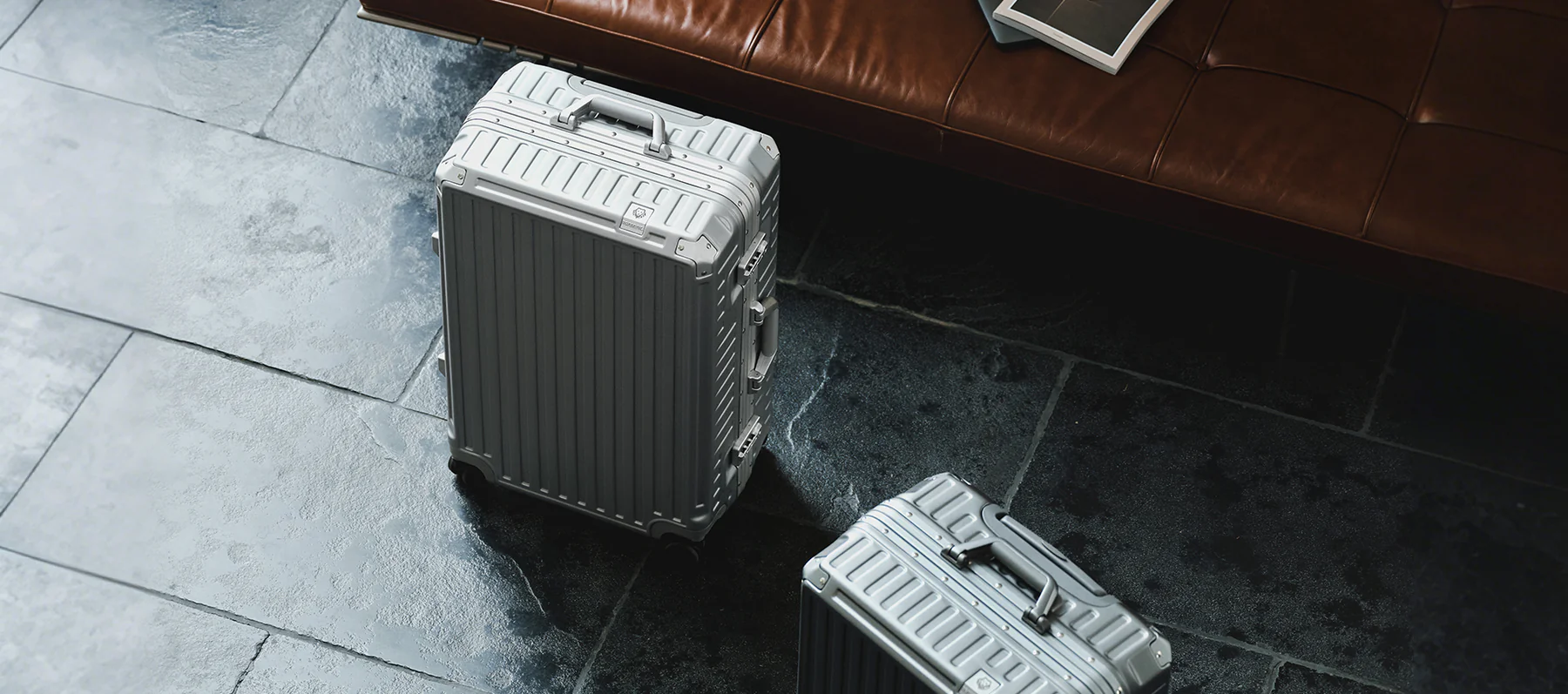
PP Luggage
↓
↳
The lightest and lowest-cost hard shell. Polypropylene flexes instead of cracking, which is why it carries entry and mid-market ranges.
The lightest and lowest-cost hard shell. Polypropylene flexes instead of cracking, which is why it carries entry and mid-market ranges.
Unlike rigid materials that fracture under heavy impact, polypropylene structurally deforms and returns to its molded geometry, fundamentally shifting how a suitcase case absorbs kinetic energy during airport handling. When evaluated at our Bogor, West Java, Indonesia facility, the material passes stringent SGS physical durability test protocols, avoiding brittle failure mechanisms entirely. The inherent flex of the polymer allows the shell to absorb extreme localized pressure, ensuring that the 75 staff executing our assembly lines deliver a shell capable of sustaining aggressive drops. We validate this elasticity through a 900 mm drop test onto a solid carbon steel impact plate at a controlled ambient temperature of 18–25°C, confirming that the polymer's memory recovers without micro-cracking.
Operating two 1,500-tonne injection machines allows PT. DJI Travel Products Indonesia to manipulate the molecular flow of polypropylene, aligning the polymer chains for maximum impact distribution across the shell surface. This alignment means a standard 37.6 × 30.5 × 65.5 cm dimension, representing a 60 L internal volume, can maintain consistent structural defense across 100+ containers per year. The group has manufactured luggage since 2011 — 14 years — and this Indonesia factory has been producing since 2025, during which time we have optimized the exact cooling cycle to lock in the material's impact-absorbing properties. The resilience of the PP shell dictates that external forces compress the air volume inside rather than snapping the polymer matrix.
Furthermore, polypropylene exhibits deep chemical resistance, protecting the outer surfaces of a suitcase case from degrading when exposed to harsh solvents or mechanical fluids on the tarmac. While undergoing the 8 km cement drum walking test, the structural integrity of the shell must also support dynamic tension without degrading. In addition to physical resilience, factors such as the exact ABS+PC blending ratios remain confirmed per order, ensuring specific performance metrics are met. We manage this robust manufacturing framework completely in-house, supported by our ongoing ISO 9001 registration process. Discover more about our production framework via our PP luggage manufacturer overview.
Polypropylene excels beyond Covestro PC primarily in its extreme elasticity and budget efficiency for heavy-duty transit, offering a highly compressible shell that survives crushing forces. However, comparing PP to PC/ABS alternatives reveals critical structural trade-offs in weight. To match the outright rigidity of a Covestro PC shell, a polypropylene suitcase case requires significantly thicker walls, which naturally increases the net weight of a 49.5 × 32 × 68.5 cm specification. While our Covestro PC models achieve immense strength at lighter mass, PP requires an increased cross-sectional profile, raising the net weight of a large format unit to 5.2 kg. The group has manufactured luggage since 2011 — 14 years — and this Indonesia factory has been producing since 2025, constantly navigating these density-to-strength ratios.
Under freezing conditions, the performance gap between polypropylene and Covestro PC becomes quantifiable through rigorous cold impact assessments. While PC maintains its impact resistance at deeply sub-zero temperatures, standard PP can exhibit reduced elasticity. At our Bogor, West Java, Indonesia testing center, we subject our PP shells to a severe -12°C for 4 hours cold drop test from 90 cm to verify that our polymer formulations do not shatter during high-altitude cargo holds. Operating with 75 staff, we continually adjust the masterbatch to expand the temperature operating window of the polymer, though Covestro PC remains the superior choice for guaranteed extreme cold weather performance without added thickness.
The decision between these polymers ultimately dictates the manufacturing approach and the final product cost matrix for our clients. Producing a PP shell on our two 1,500-tonne injection machines allows for massive volume output, scaling up to an 80,000 units/month capacity, which is highly advantageous for large retail programs. While elements like TSA lock specifications remain confirmed per order, the fundamental trade-off is fixed: PP provides unmatched crush recovery and cost efficiency, while Covestro PC delivers high rigidity at a lower net weight. For a deeper understanding of our capabilities, please consult our PP luggage manufacturer hub.
Managing the relationship between wall thickness and flex is the primary engineering challenge when developing a polypropylene suitcase case at PT. DJI Travel Products Indonesia. Because PP inherently lacks the stiffness of an aluminum frame luggage build with 5052 / 6061 alloys, structural integrity must be derived from geometry and material volume. Our 100% in-house mould making department designs complex internal ribbing matrices that add necessary rigidity without excessively ballooning the 4.88 kg net weight of a 24-inch model. The group has manufactured luggage since 2011 — 14 years — and this Indonesia factory has been producing since 2025, perfecting the exact draft angles and corner thicknesses required to stabilize the polymer.
The flex of a PP shell demands specialized integration points for external hardware to prevent components from tearing through the yielding polymer under heavy load. To ensure the YKK zippers and SilentMove wheels remain permanently anchored, we deploy reinforced backing plates and thickened mounting hubs across the 37.6 × 30.5 × 65.5 cm chassis. This meticulous reinforcement guarantees the case survives severe dynamic testing, including carrying a heavy load down 25 steps of 200 mm without hardware failure. By distributing the mechanical stress across a wider surface area of the 60 L shell, we mitigate the risk associated with PP's high elasticity.
Wall thickness also dictates performance under continuous heavy pressure, particularly when stacked in transit. Our SGS physical durability test protocols include a demanding 4-hour static load test of 40 kg specifically designed for 535–660 mm dimension classes. By optimizing the shell thickness via our two 1,500-tonne injection machines, we ensure the PP material does not permanently buckle under this sustained weight. For larger configurations, this increases to a 60 kg load for 685–835 mm models, verifying that the 80,000 units/month capacity we produce in Bogor, West Java, Indonesia meets global logistics demands. Explore our molding techniques on our PP luggage manufacturer page.
The aesthetic execution of polypropylene luggage at PT. DJI Travel Products Indonesia relies entirely on the precise tooling of our molds and the deep integration of colorants into the polymer matrix. Unlike painted Covestro PC shells, the color in our PP luggage is achieved by blending pigment masterbatches directly into the raw material prior to molding in our two 1,500-tonne injection machines. This means the hue is monolithic; a deep scratch on a 37.6 × 22.6 × 58.4 cm shell reveals the exact same color underneath, ensuring long-term visual integrity. Managing this process with our 75 staff allows us to match specific brand pantones exactly, operating strictly within our 100 pcs / SKU threshold.
Because polypropylene naturally presents a slightly waxy, matte surface, we leverage our 100% in-house mould making capabilities to apply aggressive textures that elevate the design while hiding transit scuffs. Whether applying a micro-sandblast finish or a bold geometric pattern, these textures are carved directly into the steel mold, transferring perfectly to the polymer surface during the injection cycle. The group has manufactured luggage since 2011 — 14 years — and this Indonesia factory has been producing since 2025, enabling us to engineer textures that not only look sophisticated but also add micro-rigidity to the flat panels of a 4.38 kg shell.
Surface treatments on PP must also account for hardware compatibility and environmental exposure. For instance, any exposed metallic components, such as custom pullers or badges, undergo a rigorous 16-hour neutral salt spray test conforming to ISO 9227 / ASTM B117 standards, ensuring corrosion points remain ≤3 and ≤1 mm². While inner lining materials and specific fabric weights remain confirmed per order, the external shell finish is optimized to resist UV degradation and chemical staining across 100+ containers per year. For comprehensive material selection, refer to our insights on material choices for hard shell luggage. Further finish options are detailed on our PP luggage manufacturer resource.
Initiating a polypropylene luggage program with PT. DJI Travel Products Indonesia requires a clear technical dossier to ensure our 75 staff can accurately configure our two 1,500-tonne injection machines. To begin, we require exact dimensional targets; for example, establishing if your largest size matches our standard 49.5 × 32 × 68.5 cm specification with a 5.2 kg net weight. The group has manufactured luggage since 2011 — 14 years — and this Indonesia factory has been producing since 2025, establishing standard operating procedures where defining dimensions immediately clarifies the required mold draft angles. All tooling is managed via our 100% in-house mould making facility.
Next, define the hardware and testing baseline required for your market. While our standard configuration utilizes SilentMove wheels and YKK zippers, specific deviations must be flagged early. Specify if your program requires our full suite of SGS physical durability test protocols, including the 8 km cement drum test and the demanding -12°C for 4 hours cold drop test. We currently manage an 80,000 units/month capacity in Bogor, West Java, Indonesia, and knowing your exact testing parameters allows us to schedule production efficiently. Note that specifics like TSA locks and internal lining weights remain confirmed per order.
Finally, we need your commercial parameters to map out the production timeline. Our MOQ is strictly enforced at 100 pcs / SKU, calculated by combining specific colors and sizes. While variables such as payment terms, trade terms (EXW/FOB/DDP), and mold ownership are all confirmed per order, our standard lead times are fixed: expect 7–15 working days for sampling, and 25–55 days for mass production. If new molds are required, the total timeline extends to 80 days. Submit your requirements via our contact page or explore broader capabilities at our luggage ODM portal. Connect with our engineering team directly on our PP luggage manufacturer platform.
What is the minimum order quantity for your polypropylene models? Our MOQ is strictly 100 pcs / SKU, which is calculated based on the specific combination of color and size, and is manufactured at our facility in Bogor, West Java, Indonesia.
How heavy is a standard 20-inch polypropylene shell? A standard 20-inch configuration, measuring 37.6 × 22.6 × 58.4 cm with a 39 L internal volume, has a net weight of 4.38 kg, which includes YKK zippers and SilentMove wheels.
What is the typical production timeline for a new project? For a completely new design requiring 100% in-house mould making, the total process takes 80 days; standard mass production on existing molds takes 25–55 days, with initial sampling requiring 7–15 working days.
Do your products undergo formal physical testing? Yes, we utilize SGS physical durability test protocols, including a 900 mm drop test onto a solid carbon steel impact plate at 18–25°C, and a severe -12°C for 4 hours cold drop test.
What kind of hardware is standard on your cases? We standardize on upper-tier YKK zippers and SilentMove wheels, while components subject to corrosion pass a 16-hour neutral salt spray test conforming to ISO 9227 / ASTM B117.
How long has the company been manufacturing these products? The group has manufactured luggage since 2011 — 14 years — and this Indonesia factory has been producing since 2025, operating two 1,500-tonne injection machines with 75 staff.
