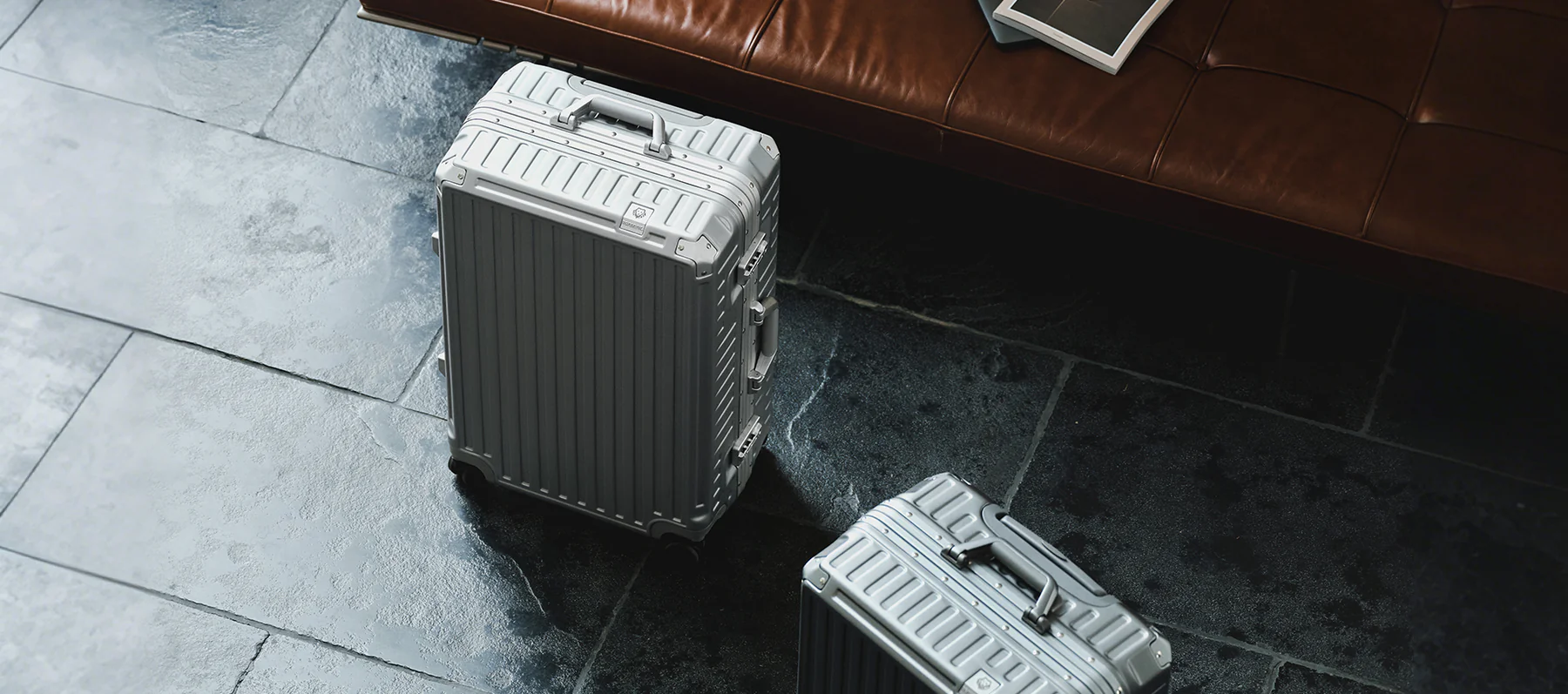
Aluminium Frame Luggage
↓
↳
An extruded 5052/6061 aluminium profile around the case mouth, on a Covestro PC or ABS+PC shell. The aluminium is the structural frame, not the whole case.
An extruded 5052/6061 aluminium profile around the case mouth, on a Covestro PC or ABS+PC shell. The aluminium is the structural frame, not the whole case.
At PT. DJI Travel Products Indonesia, we frequently clarify the structural difference between our framed luggage and fully metallic designs. A true aluminium-frame suitcase utilizes a high-grade Covestro polycarbonate or an ABS+PC shell, strictly engineered to withstand an extreme temperature range from −40 to 120 °C. The defining characteristic is the extruded 5052 or 6061 aluminium profile running precisely around the case mouth, acting as a rigid structural border. This profile is meticulously anodised to 10–12 μm, ensuring the case mouth securely holds ≥40 HWB Brinell hardness in accordance with ISO 6506 and ASTM E10 standards. The final shell wall thickness and the specific lock brand are always confirmed per order.
Conversely, a solid metal body refers to cases constructed entirely from stamped 5052 or 6061 aluminium sheets, featuring distinct ribbed panels and a heavily riveted perimeter. This complete metallic architecture defines our AURA Collection. Neither style is objectively superior; they simply rely on different physical mechanics to protect the traveler's cargo. The framed variant leverages the flexible resilience of the polymer shell paired with a reinforced metal closure, while the AURA line depends on the unyielding stiffness of full sheet metal. At our manufacturing plant in Kemang, Bogor, West Java, we engineer both categories using 100% in-house mould making, recognizing that distinct retail demographics demand different structural philosophies.
To support these diverse luggage builds, our dedicated team of 75 staff members operates advanced manufacturing equipment, which includes two powerful 1,500-tonne injection machines dedicated to shaping the polymer shells. This robust infrastructure comfortably sustains a steady production output of 80,000 units/month. For our wholesale buyers, the minimum order quantity is rigidly set at 100 pcs per SKU, uniquely counted per colour × size. Following specification approval, our standard timeline requires 7–15 working days for initial sampling, followed by 25–55 days for bulk manufacturing. Naturally, any unlisted structural details or material specifications remain confirmed per order.
When paired with a upper-tier Covestro PC or a hybrid ABS+PC shell, the extruded 5052/6061 aluminum perimeter frame serves as the structural backbone of the luggage. Rather than relying on zippers that stretch, this metal chassis carries the entire case-mouth load, ensuring absolute structural rigidity where the two main baggage halves meet. If a traveler overpacks, a traditional closure warps, compromising the seal. In contrast, the robust 5052/6061 extrusion forces the opposing shell compartments to remain perfectly aligned under severe internal pressure. This dimensional stability is why the primary Covestro PC shell wall can remain thin and lightweight without sacrificing crush resistance. By transferring localized stress away from the flexible polymer and distributing it across a rigid skeleton, the design prevents catastrophic bulging during rough handling. For brands seeking this advantage, partnering with an aluminum frame luggage manufacturer guarantees flawless integration between the rigid metal and the pliable thermoplastic, avoiding stress fractures at the critical rivet points.
Beyond holding the halves together, the perimeter extrusion actively absorbs kinetic impact directly at the vulnerable seam. During drops from cargo holds, the frame takes the brunt of the shock, shielding the delicate case mouth from permanent deformation. To ensure extreme resilience, the aluminum undergoes a finishing process resulting in an anodised thickness of 10–12 μm, providing exceptional defense against corrosion and the rigors of global travel. Structural integrity is rigorously verified, requiring the case mouth region to maintain a Brinell hardness of ≥40 HWB, strictly conforming to testing parameters outlined in both ISO 6506 and ASTM E10 standards. Furthermore, this heavy-duty chassis demonstrates remarkable thermal stability, engineered to maintain perfect closure alignment across a drastic temperature spectrum ranging from a freezing −40 °C to a blistering 120 °C. Because brands require specific load tolerances based on their demographics, the exact aluminum extrusion wall thickness is meticulously confirmed per order, allowing for custom calibration between structural capacity and weight.
Our advanced manufacturing process utilizes upper-tier extruded 5052 and 6061 aluminium alloys to produce a highly versatile perimeter frame that radically transforms luggage modularity. By standardizing the internal structural interface, this singular robust frame profile seamlessly accepts either a heavy-duty YKK zipper track or a sophisticated zipperless dual-latch closure mechanism. This remarkably interchangeable architectural framework presents a unique value proposition, specifically meaning that a buyer can smoothly keep one core shell and simply change their closure type between varying travel seasons. For extensive global itineraries, opting for the traditional YKK zippered configuration provides a significantly wider opening aperture and translates to noticeably easier packing dynamics. This enhanced structural flexibility becomes especially crucial when managing a large 28-inch checked case, as the yielding fabric tape allows the two suitcase halves to shift and expand slightly, comfortably accommodating irregular cargo. Customers seeking to build upon this highly adaptable manufacturing foundation can thoroughly explore our complete structural lineup directly via our comprehensive PC/ABS luggage catalog.
Conversely, selecting the streamlined zipperless dual-latch closure fundamentally eliminates the vulnerable fabric tape altogether, completely removing the most prominent structural wear point typically found on traditional travel baggage. This rigid, flush metal-on-metal configuration creates an exceptionally secure seal that consistently proves indispensable for busy corporate commuters relying heavily on a compact 20-inch carry-on suitcase. When navigating through congested airport terminals, the zipperless latch iteration is dramatically faster to open during a mandated security check, smoothly allowing inspection agents to instantly pop the mechanical hardware instead of wrestling a slider around curved corners. Furthermore, the total absence of soft components ensures that the geometric integrity of the aluminium perimeter frame remains fully uncompromised under heavy compression loads. Because our factory caters directly to specialized international wholesale clients, the exact latch hardware brand and the precise aluminium wall thickness are meticulously confirmed per order. This tailored production approach absolutely guarantees that every single manufacturing run perfectly matches the stringent durability thresholds required for rigorous commercial transit.
Our extruded frame begins its finishing journey through a highly controlled anodic oxidation process, purposefully formulated for 5052 and 6061 aluminium profiles. By subjecting the raw extrusion to a precise electrolytic bath, we cultivate a robust 10–12 μm oxide film that transforms the surface into a permanent environmental shield. This anodising layer guarantees exceptional corrosion resistance, rigorously verified against the parameters of the ISO 9227 and ASTM B117 standards. During the mandatory 16-hour neutral salt spray test, the treated aluminium must exhibit unyielding defense, permitting no more than three minor corrosion points, each strictly contained within a 1 mm² area. Such quality control ensures the metallic skeleton remains pristine through harsh coastal humidity. Furthermore, the porous nature of the newly formed oxide layer allows for deep pigment saturation on our dedicated anodising line, where the final colours are confirmed per order, ensuring the aesthetic integrity is as enduring as its structural foundation.
Beyond electrochemical finishing, the mechanical architecture of the case relies heavily on carefully engineered hardware integration, specifically regarding the riveted aluminium corner guards and precision-machined latch seats. The corner guards act as essential sacrificial components, deliberately designed to absorb catastrophic impact forces away from the primary shell during severe mishandling. This protective capability is physically validated through a punishing loaded 900 mm drop test, where the fully packed luggage is released directly onto a solid steel plate to ensure the chassis maintains dimensional stability. The resilience of these riveted protectors is further challenged by a 90 cm cold drop protocol, executed immediately after the unit has been soaked for 4 hours at −12 °C, simulating the unforgiving chill of high-altitude aviation cargo holds. To guarantee absolute security under such extreme dynamic loads, the latch seats are directly machined into the rigid aluminium frame itself rather than the shell material, anchoring the locking mechanisms into a steadfast metallic foundation that refuses to yield.
To initiate an accurate quotation for an aluminium-frame case, corporate buyers must provide several key specifications to our production team in Bogor, West Java, Indonesia. Outlining your precise vision upfront ensures a highly seamless, efficient transition into our dedicated Luggage ODM workflow, avoiding unnecessary delays during the critical engineering phase.
Please prepare the following 5 critical product details when submitting your initial project brief to our factory floor:
Our industrial production facility maintains a strict Minimum Order Quantity of 100 pcs per SKU, which is counted strictly per colour multiplied by size. Once specifications are fully locked, prototyping and physical sampling generally require 7–15 working days to complete. After the purchasing manager grants final approval on the physical sample, standard bulk manufacturing typically spans 25–55 days, varying slightly based on peak seasonal periods.
Beyond the initial exploratory quote, several technical and commercial variables remain to be confirmed per individual order contract. These final stage validations include the exact extrusion wall thickness, the interior fabric lining weight, your chosen security lock brand, defined AQL values for quality inspections, tiered pricing structures based on volume, payment terms, international trade terms, and any custom mould ownership clauses. Send these initial requirements over to our specialists through the Contact portal today, so we can immediately schedule your 1st strategy consultation.
Is an aluminium frame the same as a full-aluminium body? No, they are different constructions. An aluminium frame design uses an extruded 5052/6061 profile strictly around the closure area, while the body utilizes a lightweight Covestro PC or ABS+PC shell. This hybrid approach provides excellent rigidity at the case mouth without the weight penalty of full metal. Exact weight differences are confirmed per order.
How thin can the shell wall be when a frame carries the case-mouth load? Because the extruded 5052/6061 profile reinforces the vulnerable closure to reach a case mouth hardness of ≥40 HWB (ISO 6506 / ASTM E10), the Covestro PC or ABS+PC shell can safely be optimized for lighter weight. Minimum wall thickness depends on your specific shell pattern and interior, which must be carefully evaluated and confirmed per order.
Can we switch from a zipper to a latch closure without a new mould? Upgrading from a zipper to an aluminium frame closure requires careful adjustments. While the Covestro PC or ABS+PC shell material remains identical, the tooling must be modified to perfectly accommodate the extruded 5052/6061 profile hardware. The exact timeline for this new mould and sampling process is 7–15 working days, with tooling costs confirmed per order.
What keeps the frame from denting on a 900 mm loaded drop? The robust extruded 5052/6061 profile absorbs substantial impacts while maintaining structural alignment. The frame successfully withstands a 900 mm loaded drop test, plus an intense 90 cm cold drop conducted at −12 °C after 4 h. It easily tolerates extreme environments from −40 → 120 °C. Ultimate payload capacities are verified and confirmed per order.
Does the anodised profile hold colour across a production run? Yes, the extruded 5052/6061 profile receives a precise anodised 10–12 μm coating for lasting colour consistency and durability. This rigorous finish passes a 16 h salt spray test (ISO 9227 / ASTM B117), showing ≤3 corrosion points each measuring ≤1 mm². Final hue matching and exact visual finish details are thoroughly reviewed and confirmed per order.
Which sizes does the same frame profile cover? The same standardized extruded 5052/6061 profile seamlessly adapts across our primary production sizes of 20/24/26/28 inch, ensuring a uniform aesthetic. Production begins at an accessible MOQ 100 pcs per SKU. Following sampling, the standard timeline for bulk 25–55 days applies. Any non-standard dimensions outside these sizes must be assessed and confirmed per order.
