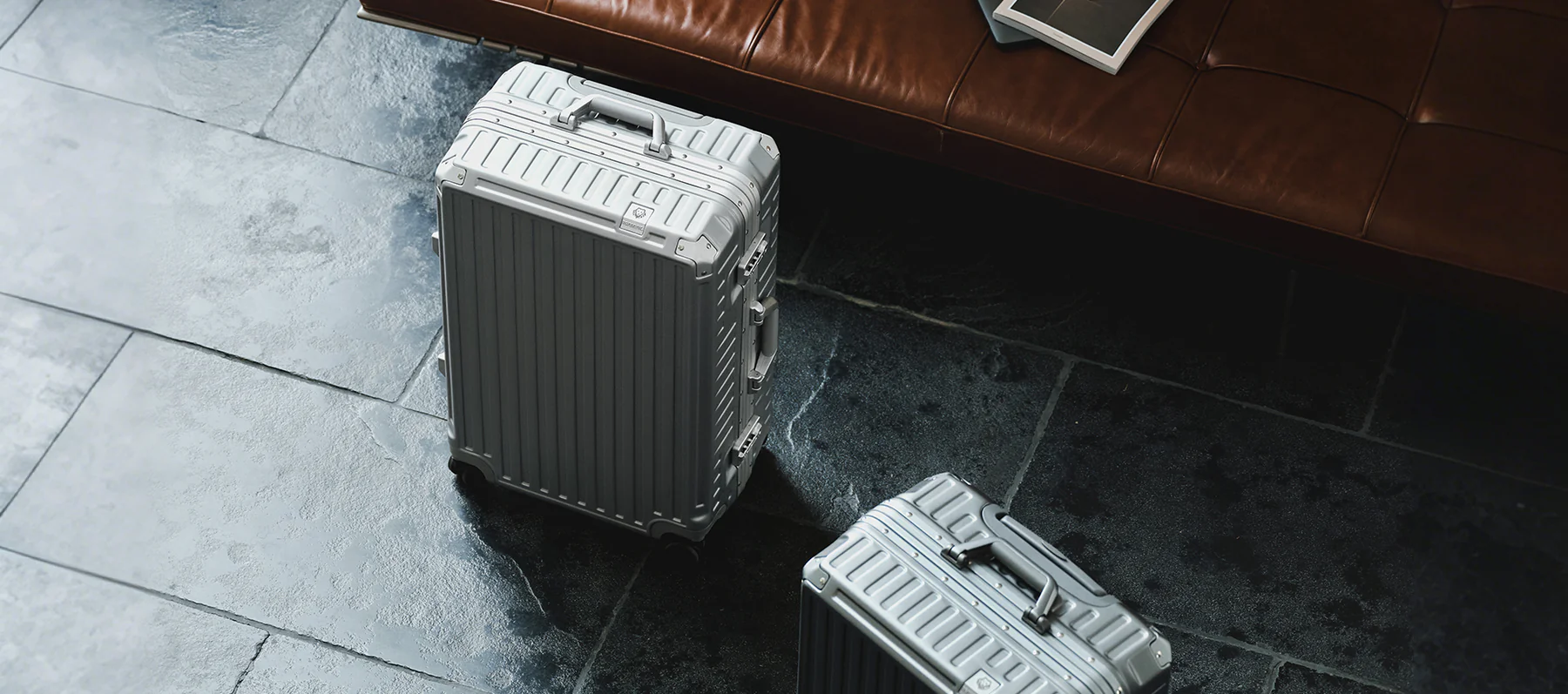
PC And ABS+PC Luggage
↓
↳
The impact-resistant hard shell. Polycarbonate (Covestro) and ABS+PC give a scratch-tolerant body in a high-gloss, matte or brushed finish.
The impact-resistant hard shell. Polycarbonate (Covestro) and ABS+PC give a scratch-tolerant body in a high-gloss, matte or brushed finish.
The performance of an ABS+PC blend hinges entirely on the ratio of Covestro PC capping the ABS substrate. Plain ABS provides structural rigidity but lacks the necessary flex needed to absorb a 900 mm drop test onto a solid carbon steel plate without fracturing. By co-extruding Covestro PC over an ABS core, the luggage shell gains the crack resistance of polycarbonate exactly where the most severe impact occurs. This is not a simple mixing process; the layers remain distinct, with the PC acting as a protective structural shield over the ABS base. The percentage of PC directly shifts the balance between the 4.88 kg net weight of a 24" case (measuring 37.6 × 30.5 × 65.5 cm) and the material cost, allowing brands to specify a shell that survives transit handling while hitting specific and competitive retail price targets.
Our two 1,500-tonne injection machines in Bogor handle both pure Covestro PC and complex blend formulations with precision. When a brand moves from a budget ABS line to an ABS+PC blend, the immediate and most noticeable upgrade is in the temperature envelope. While plain ABS turns brittle at low temperatures and shatters under stress, a proper Covestro PC layer ensures the shell survives the rigorous -12°C 4h drop test from 90 cm. The exact ABS-to-PC ratio is specified per order, balancing the cost advantages of the ABS core against the durability requirements of the target market, ranging from domestic retail shelves to heavy-duty international travel applications.
Evaluating the three materials means carefully mapping their failure points against their unit costs. Plain ABS sits at the bottom of the durability and cost curve, offering the lowest price but carrying the highest risk of cracking under our continuous 4-hour static pressure test (which applies 40 kg for 20/24" sizes and 60 kg for the 28" size). Pure Covestro PC sits at the very top of the curve, offering maximum impact absorption and temperature resistance, thereby forming the robust basis of our Voyager and Captain series. The ABS+PC blend occupies the crucial and highly popular middle ground, where the Covestro PC outer layer defends effectively against scratches and point impacts, while the ABS core maintains the structural shape of a 60 L 24" case without incurring the upper-tier material cost of 100% polycarbonate.
This strategic positioning makes the ABS+PC blend the primary volume driver for many successful brands. At our standard 100 pcs/SKU MOQ, moving a 20" (37.6 × 22.6 × 58.4 cm) case from pure PC to an ABS+PC blend noticeably reduces the ex-factory cost. This cost reduction frees up valuable margin for hardware upgrades, such as integrating SilentMove 360° wheels or utilizing 5052/6061 aluminium frames instead of standard zippers. The blend provides a visual and tactile finish identical to pure PC, meaning the retail presentation remains absolutely upper-tier. The trade-off is slightly reduced ultimate flexibility compared to pure Covestro PC, a calculation buyers must make based on their specific warranty claims history and market positioning. For deeper insights into our manufacturing capabilities for these materials, visit our ABS luggage manufacturing and PC luggage manufacturing pages.
Airline baggage systems do not test for steady, predictable loads; they test luggage for sudden shock and harsh abrasion. A pure ABS case, especially when cold from the aircraft hold, struggles significantly to absorb the kinetic energy of a drop, often leading to catastrophic corner fractures. An ABS+PC case uses its Covestro PC layer to efficiently distribute that sudden energy. The polycarbonate acts like a dynamic shock absorber, flexing just enough to prevent the brittle failure characteristic of plain ABS. This resilience is rigorously verified through our in-house drop testing protocols, where cases must survive drops onto solid carbon steel at both room temperature (18–25°C) and the demanding -12°C threshold.
Beyond simple impact resistance, the Covestro PC layer vigorously protects against the friction of conveyor belts and the aggressive scraping of other luggage during transit. Our PT. DJI Travel Products Indonesia facility ensures the extrusion process bonds the PC and ABS layers seamlessly, preventing any chance of delamination over the product's lifespan. For a large 28" case (49.5 × 32 × 68.5 cm) weighing 5.2 kg, this structural integrity means the large surface panels resist the scuffing and gouging that quickly ruins the appearance of a plain ABS shell. The blend ensures the luggage arrives on the baggage carousel looking intact and professional, substantially reducing return rates and preserving brand reputation in a competitive market. Consider how this compares to PP luggage or aluminium frame luggage for different travel demands.
The Covestro PC outer layer on an ABS+PC blend allows for advanced surface finishes that are simply not viable or durable on plain ABS. Polycarbonate takes texture exceptionally well, ranging from deep micro-diamond scratch-resistant patterns to smooth, high-gloss metallic finishes. These textures are not just aesthetic choices; they are highly functional engineering decisions. A micro-diamond finish effectively hides the inevitable scuffs generated from our stringent 8 km concrete roller and 4 km bumped belt tests, ensuring the case maintains its pristine retail appeal after multiple long-haul trips. The 100% in-house mould making capability at our Bogor plant allows brands to specify custom, proprietary textures that uniquely differentiate their product lines.
For brands targeting a sophisticated, upper-tier look, the ABS+PC blend can achieve the exact same glossy, deep-colour finish as pure Covestro PC. Because the colour and texture are carried entirely by the PC layer, the visual depth is identical to the naked eye. Whether specifying an ABS+PC blend or pure PC for a sleek Voyager series case, the surface finish must pass our 16-hour neutral salt spray test (ISO 9227 / ASTM B117) with ≤3 corrosion points. This ensures that any integrated hardware, YKK zippers, or metallic accents do not degrade the shell's appearance over time, maintaining a cohesive and durable exterior. Read more in our newsroom article on material choices for hard shell luggage.
To quote an ABS+PC or pure Covestro PC programme accurately, we require the specific material ratio, if known, or the target retail price and warranty terms so our team can recommend the optimal blend. Please include the desired size run—typically spanning 20" (39 L), 24" (60 L), and 28"—and indicate whether the design utilizes YKK zippers or a robust 5052/6061 aluminium frame. Standard turnaround is 7–15 working days for initial samples and 25–55 days for bulk production, assuming our standard 100 pcs/SKU MOQ.
If the project requires entirely new tooling, our in-house capability adds approximately 10 days for mould making and 25 days for transit, bringing the total lead time for a brand-new design to roughly 80 days. Specify any custom surface textures, exact Pantone colours, and hardware preferences like SilentMove wheels. If the precise ABS/PC ratio, inner lining weight, or wall thickness is undecided, simply note this as "confirmed per order," and our engineering team in Bogor will provide tailored options based on our SGS physical durability test protocols. We are ready to handle your luggage ODM needs from concept to final shipment, ensuring every specification meets your exact standards. Ready to start? Contact us today.
Is pure Covestro PC always better than an ABS+PC blend? Pure Covestro PC offers the highest impact resistance and flex, ideal for upper-tier lines like our Voyager series, while ABS+PC blends offer a more accessible cost unit with similar surface finishes, perfectly suited for volume retail environments.
What is the MOQ for PC and ABS+PC cases? The minimum order quantity is solidly set at 100 pcs/SKU for both pure Covestro PC and ABS+PC blends, meticulously produced at our Bogor, Indonesia facility.
Can I specify the exact ratio of PC to ABS in a blend? Yes, the specific blend ratio can be highly customized based on your unique durability requirements and cost targets, and is typically documented and confirmed per order.
Do PC and ABS+PC cases pass cold temperature drop tests? Both pure Covestro PC and properly formulated ABS+PC blends consistently pass our rigorous -12°C 4h drop test from 90 cm onto a solid carbon steel plate, significantly outperforming plain ABS luggage.
What surface textures are available for Covestro PC shells? Because our comprehensive mould making is 100% in-house, we can produce virtually anything from smooth high-gloss finishes to deep micro-diamond scratch-resistant textures directly on the PC layer.
What is the production lead time for a new ABS+PC design? For a completely new design requiring custom tooling, the total lead time is approximately 80 days (10 days mould making, 25 days transit, 45 days mass production); for existing moulds, bulk production swiftly takes 25–55 days.
