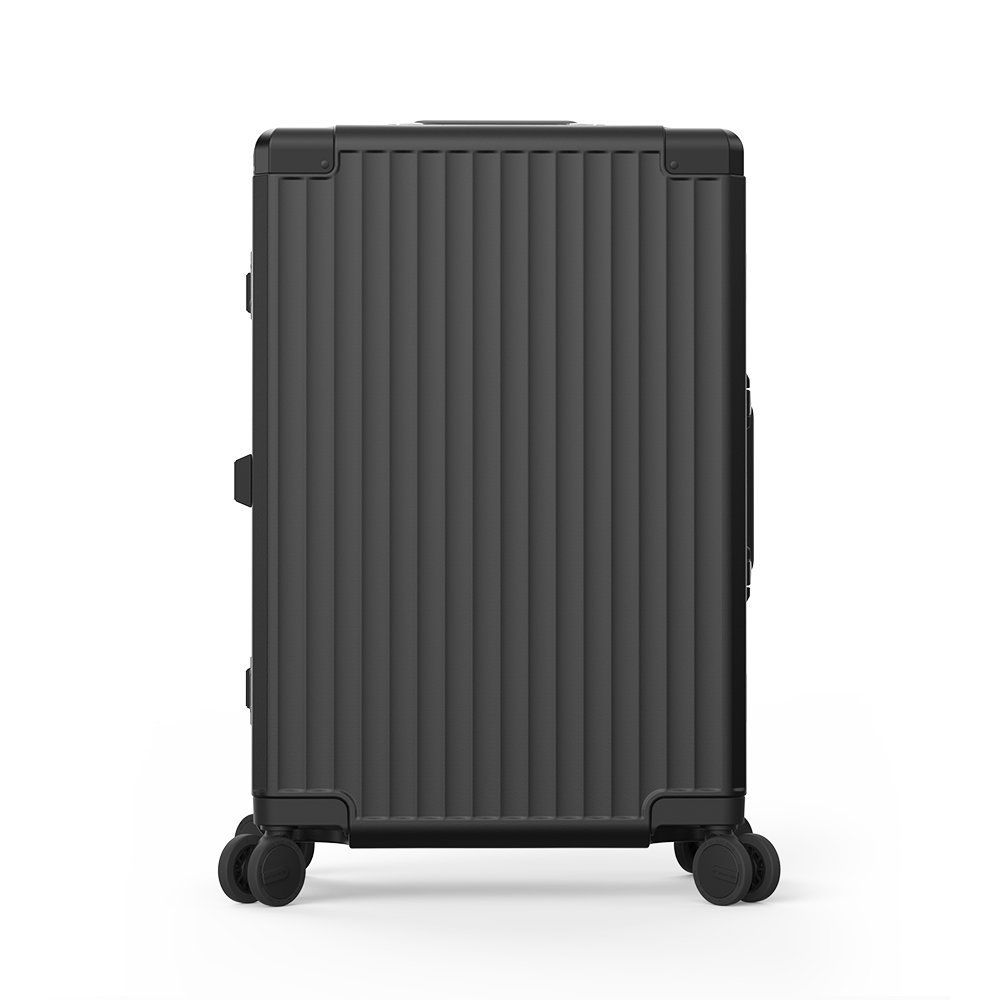
Aluminium is a component, not a category
On a suitcase, aluminium turns up in four distinct places, and a case can use any combination of them: the frame around the case mouth, the corners and closure hardware, the telescopic handle tubes, and - rarely - the body itself. Which of the four a quotation actually includes is the difference between comparing like with like and comparing two different products.
That is why "aluminium luggage" means very different things at very different price points. It is a material choice, not a single product category.
What an aluminium frame case actually is
An aluminium frame case is not a solid aluminium body. It is a polycarbonate or ABS+PC shell joined to an extruded aluminium profile frame that runs around the opening. The aluminium carries the load at the case mouth - the point where a zippered case fails first - while the shell provides the body. The frame is bent from profile and riveted closed, not welded.
If a supplier describes a case as entirely aluminium while quoting a polycarbonate shell, the specification is inconsistent. Resolve it before you pay for a sample.
Frame hardness: the number to ask for
The aluminium case mouth is tested for Brinell hardness under ISO 6506 / ASTM E10 and must reach at least 40 HWB. That figure is a core structural benchmark in our mechanical luggage testing protocol, not an optional extra. A frame below it deforms at the opening long before the shell fails, which is why a frame quotation without a hardness figure is incomplete.
How the frame is made
The profile is extruded from 5052 or 6061 aluminium alloy to the required cross-section, cut to the case perimeter, bent to the corner radii and riveted to the Covestro PC or ABS+PC shell (or to a 5052/6061 stamped metal body on our full-aluminium suitcases). The corners and the closure come from the same aluminium-magnesium alloy family as the profile. Anodising is the standard finish, with the oxide film specified at 10-12 micrometres, paired with SilentMove 360° spinner wheels.
Extrusion and anodising being outsourced is normal in this industry and not a weakness in itself. What matters is that mould making, bending, riveting and frame alignment stay inside the plant, because alignment is what the case mouth hardness ultimately depends on.
Testing that applies to aluminium frame cases
Structural testing follows our in-house and SGS physical luggage durability protocol. The aluminium-specific requirements are case mouth hardness (ISO 6506 / ASTM E10) and 16-hour neutral salt spray testing (ISO 9227 / ASTM B117), because an anodised frame is exposed to the same handling as the shell. Drop, low-temperature drop, SilentMove wheel and stacking testing apply to the completed case regardless of shell material.
- Case mouth hardness: Brinell, minimum 40 HWB under ISO 6506 / ASTM E10 (5052/6061 alloy)
- Salt spray: 16 hours neutral salt spray (ISO 9227 / ASTM B117), no more than three corrosion points, each no larger than one square millimetre
- Drop: conditioned at 18-25 °C, released from 900 mm onto a solid steel impact plate, once handle-up and once side-handle-up
- Low-temperature drop: conditioned at -12 °C for four hours, then dropped from 90 cm
- Wheel and trolley: SilentMove spinner wheels run 8 km on a cement drum plus 4 km on a cleated conveyor, wheel wear within 2 mm
One point many quotations get wrong: the roller-drum impact and falling-ball tests written for plastic shells are explicitly not applicable to metal-bodied cases. An aluminium case has to be tested against the aluminium requirements, not borrowed from the plastic test list.
Finished cases are sent to SGS for testing, which produces test reports on submitted samples rather than a product certification.
Aluminium or polycarbonate: how to decide
Most ranges carry both. A brand will put an aluminium frame line or full aluminium line at the top of the range and Covestro polycarbonate or PP below it, because the frame signals the higher price point while the plastic shells carry the volume. The aluminium frame costs more, weighs more and reads as premium; polycarbonate is lighter and absorbs impact instead of transferring it.
Neither is better in the abstract. The question is which position in your range you are filling.
Ordering aluminium luggage
- Minimum order: 100 units per SKU
- Lead time: 25-55 days from deposit and approved sample
- Payment: 30% deposit, 70% balance
- Sample development: 7-15 working days
- Monthly capacity: 80,000 units, about 70% hard shell, with 100% in-house mould making
See the aluminium frame range in the catalogue, or compare all five hard-shell routes in material choices for hard shell luggage. Read how an OEM or ODM programme is structured.
Questions buyers ask about aluminium luggage
Which aluminium alloy grade do you use for frames and full-metal bodies? We use 5052 and 6061 aluminium alloys, anodised to a 10–12 micrometre oxide layer and tested to ISO 6506 / ASTM E10 Brinell hardness ≥ 40 HWB at the case mouth.
Are your aluminium frames welded or riveted? They are bent from extruded 5052/6061 profile and riveted closed rather than welded, which preserves the temper and hardness of the alloy at the corners and closure.
What is the MOQ for custom aluminium-frame or full-aluminium suitcases? MOQ is 100 units per SKU (per colour × size combination), with 7–15 working days for sampling and 25–55 days for bulk production.
View all